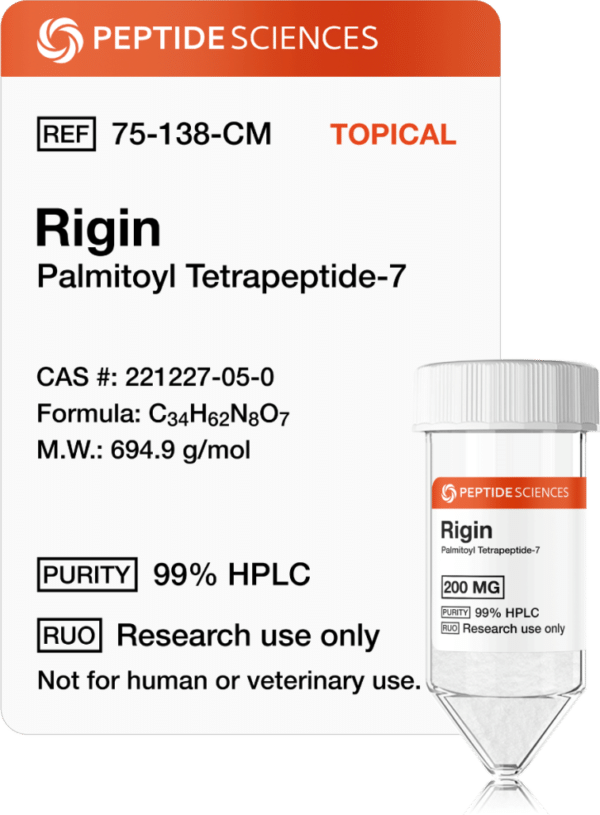
Rigin 200mg (Palmitoyl Tetrapeptide-7) Research Peptide
Rigin 200mg (Palmitoyl Tetrapeptide-7) is a lipid-modified tetrapeptide developed for research involving peptide-mediated signaling and cosmetic biology.
The peptide contains the four-residue sequence:
Gly-Gln-Pro-Arg (GQPR)
A palmitoyl chain is attached to the N-terminal region of the peptide, producing Palmitoyl-GQPR. This lipid modification substantially changes the physicochemical character of the underlying peptide by increasing its lipophilic component.
PubChem identifies the compound as N-palmitoyl-glycyl-L-glutaminyl-L-prolyl-L-arginine and lists Rigin and N-Palmitoylrigin among its synonyms.
The product quantity of 200mg refers to the amount of research material supplied and should not be confused with molecular weight or concentration.
Primary Research Classification
Rigin can be classified as:
- Synthetic lipopeptide
- Palmitoylated tetrapeptide
- Cosmetic research peptide
- Skin-biology research compound
- Inflammatory-signaling research material
- Extracellular-matrix research peptide
- Peptide structure-function model
Its primary research relevance is in skin biology, inflammatory signaling, extracellular matrix regulation, and cosmetic peptide science.
Scientific Background
Rigin is based on the short peptide sequence GQPR, also known as Tetrapeptide-7. The addition of a palmitoyl group creates Palmitoyl Tetrapeptide-7, giving the molecule a distinct lipid-peptide architecture.
Short bioactive peptides are widely investigated as signaling molecules because small changes in amino-acid sequence can alter molecular recognition, cellular interactions, stability, and biological activity.
The palmitoyl group is particularly relevant from a formulation perspective. Lipidation can change peptide partitioning into lipid environments and influence how a peptide behaves in experimental delivery systems.
Rigin has traditionally been associated with research into the biology of skin aging and inflammatory signaling. Reviews of topical peptides have described Palmitoyl Tetrapeptide-7 as a cosmetic peptide investigated in relation to IL-6 secretion and extracellular matrix structure.
However, the strength of evidence varies considerably between experimental models and finished formulations.
Mechanism of Research Interest
One of the main proposed mechanisms associated with Palmitoyl Tetrapeptide-7 involves modulation of pro-inflammatory signaling, particularly IL-6.
IL-6 is a cytokine involved in numerous biological processes, including immune signaling, inflammatory responses, and cellular communication. Because chronic inflammatory signaling is relevant to skin biology, IL-6 has become an important research marker in studies of photoaging and skin remodeling.
Published cosmetic-peptide literature has reported that Palmitoyl Tetrapeptide-7 can reduce IL-6 secretion under certain experimental conditions.
Researchers can therefore investigate Rigin within experimental models examining:
- IL-6 secretion
- Cytokine signaling
- Fibroblast responses
- Extracellular matrix organization
- Collagen-associated biology
- Dermal structural proteins
- Cellular responses to environmental stress
Importantly, the proposed mechanism should not be presented as an established therapeutic pathway. Some evidence supporting Rigin’s anti-inflammatory positioning comes from supplier-linked research and studies of multi-peptide formulations, making it difficult to isolate the contribution of Palmitoyl Tetrapeptide-7 alone.
Palmitoyl Tetrapeptide-7 and Extracellular Matrix Research
The extracellular matrix provides structural support within connective tissue and includes proteins and other macromolecules that influence tissue architecture.
Skin-aging research frequently examines changes in collagen, elastin, fibrillin-rich microfibrils, glycosaminoglycans, and other matrix components.
Palmitoyl Tetrapeptide-7 has been investigated in this broader context. A review of topical peptide treatments reported research in which a combination containing Palmitoyl Tetrapeptide-7 and another palmitoylated peptide was associated with changes in extracellular matrix structure and facial wrinkle measurements.
These findings are relevant to formulation research but require careful interpretation because combination studies cannot establish the independent contribution of Rigin.
For laboratory researchers, this distinction makes Rigin particularly interesting as a model for studying how lipidated short peptides interact with cellular and extracellular systems.
Key Research Applications
1. Inflammatory Signaling Research
Rigin can be incorporated into experimental studies examining cytokine production and inflammatory signaling, particularly IL-6-related pathways.
Researchers may evaluate changes in cytokine secretion following defined cellular stimuli.
2. Skin Biology Research
The peptide is relevant to laboratory models investigating fibroblast behavior, extracellular matrix organization, and cellular responses associated with skin aging.
3. Cosmetic Peptide Research
Palmitoyl Tetrapeptide-7 is an established subject within cosmetic peptide literature. Researchers can use it to investigate the relationship between peptide structure, lipid modification, formulation behavior, and biological signaling.
4. Extracellular Matrix Studies
Rigin can serve as a research material in experiments examining matrix-associated proteins and structural changes in dermal models.
5. Peptide-Lipid Structure Research
The palmitoyl group provides an opportunity to investigate how lipid conjugation changes the physicochemical behavior of a short peptide.
6. Comparative Peptide Research
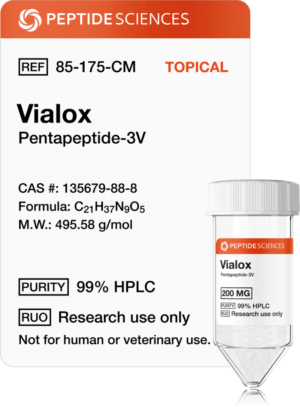
Rigin can be compared with other cosmetic peptides, including Palmitoyl Tripeptide-1, Palmitoyl Hexapeptide-12, Acetyl Hexapeptide-8, Syn-AKE, and Vialox, while maintaining careful distinctions between their molecular structures and proposed mechanisms.
Research Evidence and Limitations
The scientific literature surrounding Palmitoyl Tetrapeptide-7 requires careful evaluation.
Some reviews describe reductions in IL-6 secretion and changes in extracellular matrix-related outcomes. At the same time, independent evidence specifically testing Palmitoyl Tetrapeptide-7 alone is limited compared with the broader cosmetic-peptide literature.
A recent evidence review noted that published human studies have generally evaluated Rigin in combination products rather than as an isolated peptide, meaning observed cosmetic effects cannot necessarily be attributed to Palmitoyl Tetrapeptide-7 alone.
This is an important consideration for anyone conducting a peptide science investigation or preparing a peptide science review.
Researchers should distinguish between:
- Isolated-peptide experiments
- Multi-peptide formulations
- Supplier-sponsored studies
- Peer-reviewed independent research
- In vitro findings
- In vivo findings
- Computational predictions
- Human cosmetic studies
This evidence hierarchy helps prevent laboratory observations from being presented as established clinical outcomes.
Technical Specifications
| Property | Rigin 200mg (Palmitoyl Tetrapeptide-7) |
|---|---|
| Product Name | Rigin 200mg (Palmitoyl Tetrapeptide-7) |
| Classification | Synthetic lipopeptide |
| Peptide Type | Palmitoylated tetrapeptide |
| Core Sequence | Gly-Gln-Pro-Arg |
| One-Letter Sequence | GQPR |
| Modified Structure | Palmitoyl-GQPR |
| Molecular Formula | C₃₄H₆₂N₈O₇ |
| Molecular Weight | 694.9 g/mol |
| CAS Number | 221227-05-0 |
| PubChem CID | 10078408 |
| Product Quantity | 200mg |
| Primary Research Areas | Cosmetic biology, inflammatory signaling, extracellular matrix research |
The molecular identity and chemical specifications are based on the current PubChem record for Palmitoyl Tetrapeptide-7.
Product-specific information should be verified from the applicable Certificate of Analysis or product documentation.
Storage and Handling
Storage requirements can depend on the specific product presentation, packaging, formulation, and manufacturer specifications.
Researchers should therefore follow the storage and handling conditions supplied with the applicable product documentation rather than relying on generic recommendations.
Product-specific information should be verified from the applicable Certificate of Analysis or product documentation.
Laboratory personnel should also consult the relevant Safety Data Sheet and institutional procedures before handling research materials.
Why Researchers Choose Peptide Sciences
Researchers evaluating Rigin from Peptide Science should assess the specific documentation associated with the product and batch.
Relevant quality-assessment criteria may include:
- Confirmed peptide identity
- Batch-specific documentation
- Certificate of Analysis availability
- Analytical characterization
- HPLC and/or mass spectrometry results where provided
- Lot-specific specifications
- Product labeling
- Formulation information where applicable
Peptide Sciences can serve as a source to evaluate when selecting research peptides, but product-specific quality claims should be based on the documentation supplied for the individual batch.
A peptide science review can help researchers understand the broader literature, but literature reviews should not replace batch-specific analytical documentation when evaluating a research material.
Laboratory Research Use Only
Rigin 200mg (Palmitoyl Tetrapeptide-7) is offered for laboratory research use only.
This product description is intended for qualified research and educational purposes. It does not constitute medical advice or a recommendation for human use. Palmitoyl Tetrapeptide-7 should not be represented as a treatment, cure, or prevention for any disease or medical condition.
The evidence discussed above includes laboratory, cosmetic, formulation, and combination-product research. These findings should not be interpreted as proof of clinical efficacy for the isolated peptide.
No human or animal dosing instructions are provided.
Researchers are responsible for complying with applicable laboratory procedures, institutional requirements, safety standards, and regulations.