Vialox (Pentapeptide-3V): Scientific Research Overview
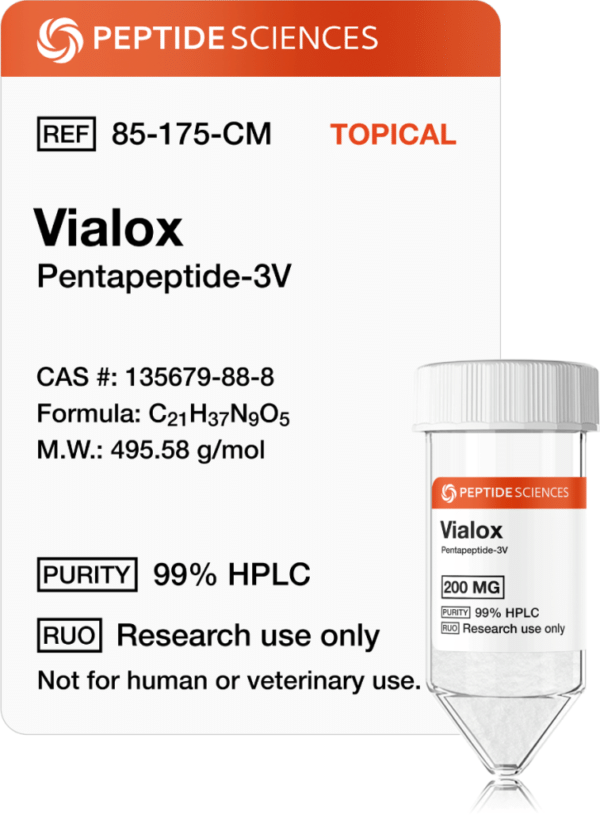
Vialox (Pentapeptide-3V) is a synthetic pentapeptide associated with cosmetic peptide research and studies of neuromuscular receptor signaling. The compound is commonly identified in scientific databases as Pentapeptide-3 or Vialox Peptide.
PubChem describes Pentapeptide-3 as glycyl-L-prolyl-L-arginyl-L-prolyl-L-alaninamide, with the sequence GPRPA. The C-terminal alanine is present as an amide, giving the peptide the condensed structure H-Gly-Pro-Arg-Pro-Ala-NH₂.
A separate PubChem record describes the diacetate salt of Vialox Pentapeptide-3. That form contains two acetic acid components and has the molecular formula C25H45N9O9 with a reported molecular weight of approximately 615.7 g/mol.
This distinction matters when evaluating technical documentation. The free peptide and diacetate salt should not be treated as interchangeable analytical entities.
Primary Research Classification
Vialox can be classified as:
- Synthetic pentapeptide
- Cosmetic peptide research compound
- Peptide–receptor interaction model
- Acetylcholine receptor research compound
- Neuromuscular signaling research peptide
- Expression-line research ingredient
- Peptide structure–activity research model
Unlike peptide hormones such as GLP-1 analogues or growth-hormone secretagogues, Vialox is primarily studied for its relationship to acetylcholine-mediated neuromuscular signaling.
Scientific Background
Pentapeptide-3 is a small synthetic peptide developed in the context of research into venom-inspired cosmetic peptides. Literature describes Vialox as being related conceptually to waglerin-1, a peptide associated with the venom of Tropidolaemus wagleri. Waglerin-1 has been investigated for its effects on muscle-type nicotinic acetylcholine receptors and neuromuscular transmission.
Vialox is not simply another name for native waglerin-1. It is a much smaller synthetic pentapeptide with its own molecular structure. Its sequence is:
Gly-Pro-Arg-Pro-Ala (GPRPA)
The molecule contains four peptide bonds and a C-terminal amide. The presence of proline residues gives the peptide a conformational profile that is relevant to structure–activity studies, while the arginine residue contributes a positively charged guanidinium group that may participate in molecular recognition.
PubChem lists the parent Pentapeptide-3 as C21H37N9O5, with a molecular weight of approximately 495.6 g/mol.
Mechanism of Research Interest
The main mechanistic interest in Vialox involves the acetylcholine receptor at the postsynaptic membrane of muscle cells.
Acetylcholine is a neurotransmitter that activates nicotinic acetylcholine receptors. At the neuromuscular junction, activation of these ligand-gated ion channels contributes to membrane depolarization and subsequent muscle contraction.
Published literature describes Pentapeptide-3/Vialox as a competitive antagonist of the postsynaptic acetylcholine receptor. In this research model, receptor antagonism can interfere with acetylcholine-dependent ion-channel activation and therefore influence muscle-cell depolarization and contraction.
This mechanism provides the scientific basis for investigating Vialox in cosmetic peptide research focused on dynamic facial expression lines. Repeated contraction of facial muscles is one biological factor associated with the formation of expression wrinkles.
However, receptor antagonism observed in experimental models should not automatically be interpreted as proof of a clinically meaningful cosmetic effect. The strength of evidence depends on the experimental system, formulation, concentration, exposure conditions, and study design.
Molecular Structure and Peptide Characteristics
Vialox is a five-residue peptide:
Gly-Pro-Arg-Pro-Ala-NH₂
The sequence can be represented using the standard one-letter amino-acid code as:
GPRPA
Its structural characteristics include:
- Five amino-acid residues
- Glycine at the N-terminus
- Two proline residues
- Arginine as the central charged residue
- Alanine at the C-terminus
- C-terminal amidation
- Synthetic peptide architecture
The arginine residue is particularly relevant to molecular recognition because its guanidinium group can participate in electrostatic and hydrogen-bonding interactions with biological targets.
The two proline residues can also influence peptide conformation because proline restricts backbone flexibility relative to many other amino acids.
These features make Vialox useful for laboratory research into peptide conformation, molecular recognition, receptor interactions, and structure–activity relationships.
Vialox and Acetylcholine Receptor Research
The acetylcholine receptor is a major component of neuromuscular communication. Nicotinic acetylcholine receptors are ligand-gated ion channels that respond rapidly to acetylcholine.
Research into venom-derived peptides such as waglerin-1 has helped characterize receptor interactions involved in neuromuscular transmission. Vialox extends this general research concept into a much smaller synthetic peptide framework.
For researchers, this creates several areas of interest:
- Competitive receptor interactions
- Postsynaptic signaling
- Ligand-gated ion-channel biology
- Muscle-cell membrane activity
- Peptide–protein recognition
- Structure–activity relationships
- Synthetic peptide design
The mechanism should be described as a research model, rather than as evidence of a therapeutic neuromuscular effect.
Cosmetic and Skin-Aging Research
Vialox is especially associated with cosmetic peptide research because of its proposed relationship to facial muscle activity and expression lines.
A 2020 review of cosmeceutical peptides describes Pentapeptide-3 as a Vialox ingredient associated with acetylcholine receptor antagonism and reports manufacturer-supplied findings involving muscle-cell contraction and wrinkle-related endpoints. The same review noted that independent investigations directly establishing anti-wrinkle properties were limited at that time.
More recent research has expanded the scientific investigation. A 2025 study examined Pentapeptide-3 using quantum-chemical calculations, spectroscopy, molecular docking, molecular-dynamics simulations, and ADME modeling. The study investigated predicted interactions with targets including TGF-β receptor 1, MAPK14, AKT1, and TNF-α.
A 2026 study further combined in-silico molecular modeling and in-vitro testing to investigate Vialox and another cosmetic pentapeptide. These newer studies are useful for understanding possible molecular interactions, but computational binding predictions and laboratory assays do not by themselves establish clinical efficacy.
Key Research Applications
1. Acetylcholine Receptor Research
Vialox can be investigated as a small peptide model for studying acetylcholine receptor interactions and postsynaptic neuromuscular signaling.
2. Peptide–Protein Interaction Studies
The defined GPRPA sequence allows researchers to examine how a compact peptide structure interacts with biological macromolecules.
3. Structure–Activity Relationship Research
Researchers can investigate how individual amino-acid residues, peptide conformation, terminal modification, and charge distribution influence molecular activity.
4. Cosmetic Peptide Research
Vialox is relevant to experimental studies involving expression lines, facial muscle activity, skin appearance, and peptide-based cosmetic mechanisms.
5. Molecular Modeling
The compound can be evaluated using computational approaches such as molecular docking, molecular dynamics, quantum-chemical calculations, and other structure-based methods. Recent research has explored several skin-aging-associated protein targets through these approaches.
6. Formulation Research
Where a validated formulation is available, researchers may investigate peptide stability, compatibility, delivery, and molecular behavior within experimental cosmetic systems. Formulation performance should always be evaluated using the complete formulation rather than assuming that activity of the isolated peptide will translate directly to a finished product.
Technical Specifications
| Specification | Vialox (Pentapeptide-3V) |
|---|---|
| Product Name | Vialox (Pentapeptide-3V) |
| Scientific Name | Pentapeptide-3 |
| Synonyms | Vialox Peptide, Glycyl-L-prolyl-L-arginyl-L-prolyl-L-alaninamide |
| Peptide Sequence | GPRPA |
| Condensed Structure | H-Gly-Pro-Arg-Pro-Ala-NH₂ |
| Classification | Synthetic pentapeptide |
| Parent Molecular Formula | C21H37N9O5 |
| Parent Molecular Weight | 495.6 g/mol |
| PubChem CID | 11605666 |
| Diacetate Form | Vialox Peptide(Pentapeptide-3) diacetate |
| Diacetate Formula | C25H45N9O9 |
| Diacetate Molecular Weight | 615.7 g/mol |
| Primary Research Interest | Acetylcholine receptor / neuromuscular signaling |
| Product Quantity | Product-specific information should be verified from the applicable Certificate of Analysis or product documentation. |
| Purity | Product-specific information should be verified from the applicable Certificate of Analysis or product documentation. |
| Analytical Testing | Product-specific information should be verified from the applicable Certificate of Analysis or product documentation. |
| Storage | Product-specific information should be verified from the applicable Certificate of Analysis or product documentation. |
The molecular information above is based on PubChem records for Pentapeptide-3 and its diacetate form. Researchers should verify the exact chemical form supplied in the applicable product documentation before comparing molecular weights or analytical data.
Storage and Handling
Storage requirements should be determined from the current product documentation for the specific batch and chemical form. Peptide stability can depend on factors including temperature, moisture, formulation, container conditions, and the presence of counterions or other formulation components.
Product-specific information should be verified from the applicable Certificate of Analysis or product documentation.
Researchers should consult applicable safety documentation and follow established laboratory procedures for handling synthetic research compounds.
Why Researchers Choose Peptide Sciences
Researchers evaluating Vialox from Peptide Sciences should focus on verifiable product information rather than unsupported performance claims.
Important attributes to review include:
- Confirmed peptide identity
- Exact chemical form
- Batch identification
- Certificate of Analysis availability
- Analytical characterization
- Documented purity
- Applicable formulation information
- Safety documentation
When comparing Peptide Sciences products, researchers should ensure that the chemical form, sequence, molecular weight, and batch documentation correspond to the exact material being evaluated.
The search term “peptide science” may also appear in online searches for peptide suppliers and research compounds, but terminology alone does not establish product quality or analytical validity. Researchers should rely on the applicable product documentation and batch-specific evidence.
Research Evidence and Limitations
The research surrounding Vialox provides a scientifically interesting connection between synthetic peptide structure, acetylcholine receptor signaling, neuromuscular activity, and cosmetic peptide research.
However, the evidence should be interpreted within its proper context.
Some reported cosmetic findings originate from manufacturer-sponsored or manufacturer-supplied data, while more recent academic work has used computational modeling and in-vitro methods. These different forms of evidence have different strengths and limitations.
In particular, predicted interactions with TGF-β receptor 1, MAPK14, AKT1, or TNF-α should not be presented as confirmed physiological mechanisms without appropriate experimental validation. The same principle applies to translating in-vitro muscle-cell findings into human cosmetic outcomes.
Vialox should therefore be positioned as a laboratory research compound rather than an established medical or therapeutic intervention.
Laboratory Research Use Only
Vialox (Pentapeptide-3V) is presented for laboratory research and experimental use only. This product description is intended for qualified researchers and provides scientific information about the compound’s molecular characteristics and research applications.
Nothing on this page should be interpreted as medical advice or as a claim that Vialox diagnoses, treats, cures, or prevents any disease or medical condition.
No human or animal dosing instructions are provided. Researchers are responsible for establishing appropriate experimental conditions in accordance with institutional protocols, applicable safety requirements, and relevant regulations.