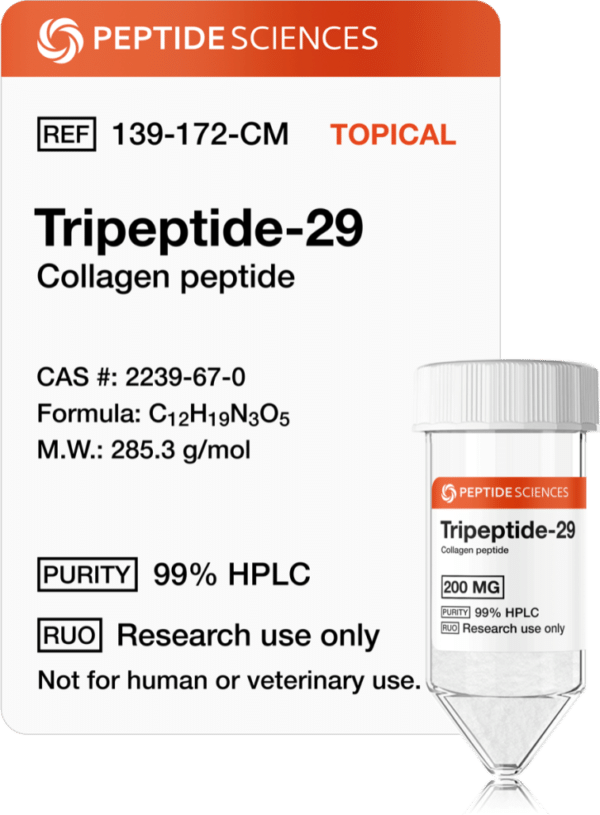
Tripeptide-29 200mg for Laboratory Research
Tripeptide-29 200mg is a short-chain peptide studied in the context of collagen and extracellular matrix research. Short peptide fragments can provide useful experimental models for investigating molecular recognition, protein interactions, cellular communication, and matrix biology.
Collagen is one of the primary structural proteins in connective tissues and plays an important role in maintaining extracellular architecture. Because collagen-related signaling involves interactions among proteins, peptides, receptors, enzymes, and extracellular matrix components, defined peptide fragments can be valuable research tools.
Tripeptide-29 is therefore of interest to researchers studying the relationship between peptide structure and extracellular matrix biology. Rather than treating the peptide as an established therapeutic agent, laboratory investigations can examine its biochemical characteristics and behavior under controlled experimental conditions.
The Tripeptide-29 200mg designation identifies the product size supplied for research applications. Additional product-specific characteristics should always be confirmed using current batch documentation.
Primary Research Classification
Tripeptide-29 can be classified broadly as a research peptide associated with collagen and extracellular matrix studies.
Areas of scientific interest may include:
- Collagen-related molecular research
- Extracellular matrix biology
- Peptide–protein interactions
- Cellular signaling research
- Structural peptide studies
- Matrix-associated cellular pathways
- Protein recognition and binding research
- Experimental biomaterials research
The biological effects of short peptides can vary according to sequence, concentration, experimental system, formulation, and biological context. Findings from one experimental model should not automatically be interpreted as evidence of an equivalent effect in humans.
Scientific Background
Collagen is a fibrous protein characterized by a highly organized molecular structure. Its distinctive triple-helical architecture and repetitive amino-acid composition contribute to the mechanical and structural properties of many tissues.
Research into collagen-derived peptides has expanded because peptide fragments can serve as experimental models for studying biological recognition and extracellular matrix communication. Some collagen-associated peptide sequences have been investigated for their interactions with cellular and molecular systems.
Tripeptide-29 is relevant to this broader field because researchers can use defined short-chain peptides to examine how molecular structure relates to biological activity. Such investigations may include peptide stability, molecular interactions, cellular responses, and changes in matrix-associated signaling.
Importantly, the presence of a peptide sequence associated with collagen does not by itself establish a therapeutic effect. Experimental observations must be evaluated according to the model, methodology, controls, and supporting evidence.
Mechanism of Research Interest
The scientific interest in Tripeptide-29 centers on the possibility that a small peptide can participate in molecular recognition and influence biological processes under specific experimental conditions.
Researchers may investigate several mechanisms, including:
Peptide–Protein Interactions
Short peptides can interact with larger proteins through molecular recognition processes. These interactions may depend on amino-acid sequence, charge, conformation, hydrophobicity, and the surrounding biochemical environment.
Extracellular Matrix Signaling
The extracellular matrix is an active biological environment rather than simply a structural framework. Matrix proteins and their fragments can interact with cells and influence signaling networks involved in cellular behavior.
Tripeptide-29 may therefore be useful in experimental systems designed to investigate how defined peptide structures relate to matrix-associated signaling.
Cellular Pathways
Laboratory studies may examine whether exposure to a research peptide is associated with measurable changes in cellular signaling pathways. Depending on the experimental model, investigators may evaluate protein expression, transcriptional responses, enzyme activity, or other molecular endpoints.
These mechanisms remain areas for investigation rather than established clinical conclusions.
Key Research Applications
Tripeptide-29 200mg may be incorporated into laboratory research involving:
- Collagen research: Investigating molecular features associated with collagen and collagen-derived peptide fragments.
- Extracellular matrix studies: Examining interactions between peptide molecules and matrix-related biological systems.
- Cell signaling research: Studying cellular responses to defined peptide environments.
- Molecular interaction studies: Evaluating peptide–protein recognition and binding behavior.
- Structural biology: Exploring relationships between peptide sequence, molecular structure, and experimental activity.
- Biomaterials research: Investigating peptide-containing systems relevant to extracellular matrix models.
- Comparative peptide research: Comparing short peptide structures and their behavior in controlled experimental settings.
Researchers should design experiments according to appropriate laboratory protocols and validate findings using suitable controls and analytical methods.
Technical Specifications
| Specification | Product Information |
|---|---|
| Product Name | Tripeptide-29 200mg |
| Research Classification | Research peptide |
| Product Quantity | 200mg |
| Peptide Type | Short-chain peptide |
| Primary Research Area | Collagen and extracellular matrix research |
| Molecular Formula | Product-specific information should be verified from the applicable Certificate of Analysis or product documentation. |
| Molecular Weight | Product-specific information should be verified from the applicable Certificate of Analysis or product documentation. |
| Purity | Product-specific information should be verified from the applicable Certificate of Analysis or product documentation. |
| Analytical Testing | Product-specific information should be verified from the applicable Certificate of Analysis or product documentation. |
| Batch Information | Refer to applicable product documentation. |
| Formulation | Product-specific information should be verified from the applicable product documentation. |
This approach avoids assigning unverified molecular or analytical specifications to the product.
Storage and Handling
Proper storage and handling are important for maintaining the integrity of research peptides. However, storage conditions can depend on the specific formulation, packaging, preparation state, and manufacturer specifications.
For Tripeptide-29 200mg, researchers should follow the storage and handling information supplied with the applicable product documentation.
Product-specific information should be verified from the applicable Certificate of Analysis or product documentation.
Researchers should also use appropriate laboratory handling practices and protect research materials from conditions that could compromise sample integrity.
Why Researchers Choose Peptide Sciences
Researchers evaluating peptide suppliers generally look for reliable product identification, transparent documentation, and appropriate analytical information.
When selecting Tripeptide-29 200mg from Peptide Sciences, researchers should evaluate verified batch-specific information rather than relying on generalized claims.
Relevant documentation may include:
- Peptide identity
- Batch information
- Certificate of Analysis availability
- Analytical characterization
- Purity information
- HPLC or MS data where applicable
- Formulation details
- Storage information
Only characteristics actually documented for the applicable batch should be used when evaluating product quality.
For researchers comparing suppliers, searches may sometimes include commercial phrases such as “Peptide Sciences coupon code” or “peptide sciences discount code.” These search terms relate to purchasing information rather than the scientific properties of Tripeptide-29. Any promotional offer, if available, should be confirmed directly through the applicable purchasing channel and should not be interpreted as evidence of peptide quality or scientific performance.
Research Considerations
Tripeptide-29 research should be interpreted within the limitations of the experimental model.
Important considerations include:
- Results from cell-based studies may not predict responses in living organisms.
- Animal research cannot automatically be translated into human outcomes.
- Peptide stability may vary according to experimental conditions.
- Biological activity can depend on peptide concentration and assay design.
- Different formulations may produce different experimental characteristics.
- Additional validation may be required before drawing mechanistic conclusions.
These considerations are especially important when studying peptides associated with complex biological systems such as collagen and the extracellular matrix.
Laboratory Research Use Only
Tripeptide-29 200mg is intended for laboratory research use only. It is not intended for human consumption, self-administration, diagnosis, treatment, prevention, or mitigation of any disease or medical condition.
This product description does not provide human or animal dosing instructions and should not be interpreted as medical guidance. Researchers are responsible for following applicable institutional procedures, laboratory safety requirements, and relevant laws and regulations.
Scientific evidence concerning Tripeptide-29 may be preliminary or model-dependent. Claims regarding therapeutic, cosmetic, regenerative, or clinical effects should not be inferred unless supported by appropriate evidence.
For the most accurate product information, researchers should consult the current product documentation and applicable Certificate of Analysis.
Product Summary
Tripeptide-29 200mg provides researchers with a defined short-peptide material for laboratory investigations involving collagen biology, extracellular matrix research, molecular interactions, and cellular signaling.
Its value as a research material lies in enabling controlled investigation of peptide structure and biological interactions. Researchers can examine how a defined peptide behaves within specific experimental systems while measuring appropriate molecular and cellular endpoints.
For scientists searching for Peptide Science resources, Tripeptide-29 represents a specialized research product within the broader field of peptide and extracellular matrix studies. As with other research peptides, experimental findings should be evaluated carefully and supported by appropriate analytical and biological controls.