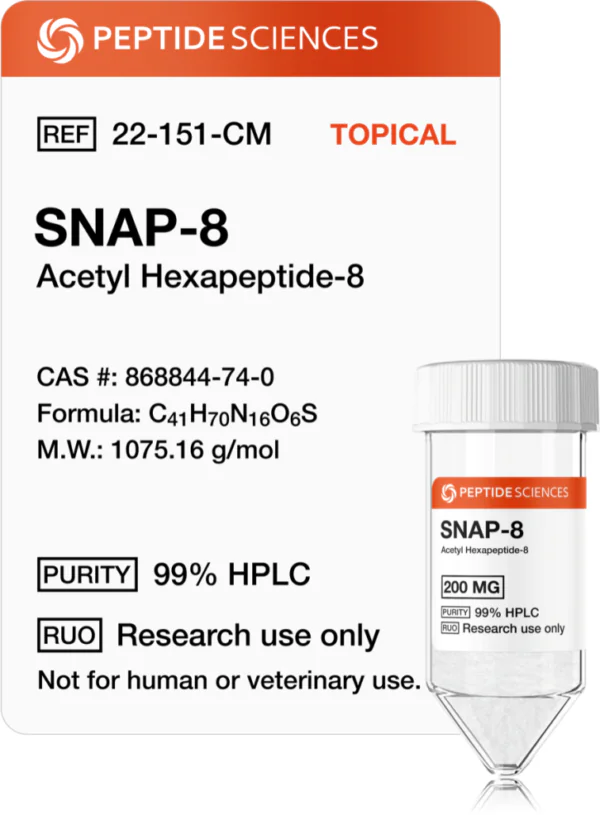
SNAP-8 200mg: Scientific Research Overview
SNAP-8 200mg is a synthetic octapeptide commonly identified by the chemical name Acetyl Octapeptide-3. It belongs to a class of short synthetic peptides developed to model specific molecular interactions associated with the SNAP-25 protein and SNARE-mediated vesicle fusion.
SNAP-8 is closely related structurally to Acetyl Hexapeptide-8, commonly known as Argireline. However, the two compounds should not be treated as identical molecules. SNAP-8 extends the relevant peptide sequence and contains eight amino-acid residues rather than six.
The documented sequence is:
Ac-Glu-Glu-Met-Gln-Arg-Arg-Ala-Asp-NH₂
Using one-letter amino-acid notation, the core sequence is commonly represented as:
EEMQRRAD
with an N-terminal acetyl group and C-terminal amide. PubChem lists the complete chemical record under Acetyl Octapeptide-3 and identifies SNAP-8 as a synonym.
The 200mg designation refers to the amount of product material and should not be confused with the molecular weight of the individual peptide molecule.
Primary Research Classification
SNAP-8 can be classified as:
- Synthetic octapeptide
- Acetylated peptide
- C-terminal amidated peptide
- SNAP-25-derived research peptide
- SNARE-associated research compound
- Peptide–protein interaction model
- Cosmetic peptide research ingredient
- Neuromuscular signaling research compound
Its primary scientific interest is not related to metabolic hormone signaling. Instead, SNAP-8 is investigated in connection with SNARE proteins, synaptic vesicle fusion, neurotransmitter release, and muscle contraction.
Scientific Background
To understand SNAP-8, it is useful to examine SNAP-25, or synaptosomal-associated protein 25.
SNAP-25 is a component of the SNARE complex, a molecular machinery responsible for membrane fusion during synaptic vesicle release. The SNARE complex helps bring vesicle and cell membranes into close proximity, allowing neurotransmitters to be released into the synaptic space.
The core SNARE machinery includes proteins such as:
- SNAP-25
- Syntaxin
- Synaptobrevin/VAMP
Together, these proteins participate in the molecular process that enables regulated vesicle fusion.
SNAP-8 was designed around a short sequence derived from the C-terminal region of SNAP-25. Its research value comes from examining whether a small peptide fragment can participate in molecular interactions relevant to this larger protein system.
This makes SNAP-8 particularly useful for research into peptide–protein recognition, protein docking, synaptic signaling, and structure–activity relationships.
Molecular Structure
The current PubChem record identifies Acetyl Octapeptide-3 as:
Ac-Glu-Glu-Met-Gln-Arg-Arg-Ala-Asp-NH₂
The peptide therefore contains:
- Glutamic acid
- Glutamic acid
- Methionine
- Glutamine
- Arginine
- Arginine
- Alanine
- Aspartic acid
The N-terminal acetyl group and C-terminal amide are important structural modifications because terminal chemistry can influence peptide charge, stability, molecular recognition, and interactions with proteins.
PubChem reports:
Molecular formula: C₄₁H₇₀N₁₆O₁₆S
Molecular weight: 1,075.2 g/mol
CAS: 868844-74-0
PubChem CID: 76283482
Some online databases contain conflicting records for Acetyl Octapeptide-3, including a separate entry with a different molecular formula and molecular weight. For this product page, the PubChem CID 76283482 record is used because it corresponds to the acetylated, C-terminally amidated structure and CAS number associated with SNAP-8.
Mechanism of Research Interest
The central scientific interest in SNAP-8 involves the SNARE-mediated vesicle fusion pathway.
SNAP-25 contributes two α-helical regions to the SNARE complex. During synaptic vesicle fusion, these regions interact with syntaxin and synaptobrevin/VAMP to form a tightly associated protein complex.
This assembly helps position the synaptic vesicle close to the plasma membrane and supports membrane fusion.
Because SNAP-8 is derived from a region of SNAP-25, researchers have investigated whether the peptide can interact with components of this molecular machinery and interfere with processes associated with complex assembly.
This is relevant to facial-expression research because neurotransmitter release at neuromuscular junctions ultimately contributes to muscle activation. Reducing signaling within this pathway could theoretically influence muscle contraction.
However, the exact behavior of a short synthetic peptide cannot simply be assumed to reproduce the activity of the full-length SNAP-25 protein. Experimental conditions, peptide concentration, formulation, cellular environment, and molecular accessibility can all influence observed activity.
SNAP-8 and SNARE Protein Research
The SNARE complex is one of the most important molecular systems involved in regulated exocytosis.
SNARE proteins facilitate membrane fusion through interactions between complementary protein domains. SNAP-25 contributes to this process through its interaction with syntaxin and synaptobrevin/VAMP.
For peptide researchers, SNAP-8 provides an interesting simplified molecular system for studying:
- Protein–peptide binding
- SNARE-associated interactions
- Molecular recognition
- Peptide structure and conformation
- Competitive peptide interactions
- Vesicle-fusion biology
- Structure–activity relationships
These applications make SNAP-8 relevant beyond cosmetic research. The peptide can also serve as a model compound in broader investigations of cellular signaling and membrane trafficking.
Cosmetic and Expression-Line Research
SNAP-8 has received significant interest in cosmetic peptide research because facial expression lines are associated with repeated muscle activity.
The proposed research model is:
SNAP-8 → peptide–protein interaction → SNARE-related signaling → neurotransmitter release → muscle activation → expression-line biology
This pathway should be regarded as a research framework, not as proof that SNAP-8 produces a specific clinical or cosmetic outcome.
Cosmetic peptide research often investigates whether short peptides can influence molecular processes associated with facial muscle activity. Such studies may use biochemical assays, cell-based systems, reconstructed skin models, or controlled topical formulations.
Results from these models should not automatically be extrapolated to humans. In particular, a peptide’s activity in a biochemical assay does not establish equivalent activity after incorporation into a finished cosmetic formulation.
SNAP-8 Compared With Argireline
SNAP-8 and Acetyl Hexapeptide-8 (Argireline) are closely related research peptides, but they are not identical.
Argireline is based on a shorter sequence, while SNAP-8 contains the longer octapeptide sequence:
Ac-EEMQRRAD-NH₂
This difference changes the molecular composition, molecular weight, and potentially the peptide’s interaction profile.
Researchers comparing the two compounds should therefore evaluate each peptide using its own:
- Sequence
- Chemical structure
- Terminal modifications
- Molecular weight
- Formulation
- Analytical characterization
- Experimental evidence
Structural similarity is useful for research classification but does not establish identical biological activity.
Key Research Applications
1. SNARE Complex Research
SNAP-8 can be investigated in laboratory systems examining molecular interactions involving SNAP-25 and other SNARE-associated proteins.
2. Peptide–Protein Interaction Studies
Its defined sequence makes it useful for studying how short peptides interact with larger protein structures.
3. Vesicle-Fusion Research
Researchers can examine peptide effects within experimental models of membrane fusion and regulated exocytosis.
4. Neuromuscular Signaling Research
SNAP-8 is relevant to research investigating the molecular relationship between neurotransmitter release and muscle activation.
5. Cosmetic Peptide Research
The compound can be studied in experimental models involving facial-expression biology, skin-aging research, and peptide-based cosmetic formulations.
6. Structure–Activity Studies
Researchers can compare SNAP-8 with related peptides to determine how sequence length and terminal modifications influence molecular interactions.
7. Computational Research
Molecular docking, molecular dynamics, structural modeling, and related computational techniques can be used to explore potential peptide–protein interactions.
Technical Specifications
| Specification | SNAP-8 200mg |
|---|---|
| Product Name | SNAP-8 200mg |
| Scientific Name | Acetyl Octapeptide-3 |
| Common Name | SNAP-8 |
| Classification | Synthetic octapeptide |
| Sequence | Ac-Glu-Glu-Met-Gln-Arg-Arg-Ala-Asp-NH₂ |
| Core Sequence | EEMQRRAD |
| N-Terminal Modification | Acetylation |
| C-Terminal Modification | Amidation |
| Molecular Formula | C₄₁H₇₀N₁₆O₁₆S |
| Molecular Weight | 1,075.2 g/mol |
| CAS Number | 868844-74-0 |
| PubChem CID | 76283482 |
| Research Focus | SNARE-associated signaling and peptide–protein interactions |
| Product Quantity | 200mg |
| Purity | Product-specific information should be verified from the applicable Certificate of Analysis or product documentation. |
| Analytical Testing | Product-specific information should be verified from the applicable Certificate of Analysis or product documentation. |
| Storage | Product-specific information should be verified from the applicable Certificate of Analysis or product documentation. |
| Formulation | Product-specific information should be verified from the applicable Certificate of Analysis or product documentation. |
The chemical identity information is based on the current PubChem record for Acetyl Octapeptide-3.
Storage and Handling
Storage conditions should always be based on the documentation supplied for the specific SNAP-8 200mg product and batch.
Peptide stability can depend on factors including moisture, temperature, formulation, container conditions, and the chemical form of the material.
Product-specific information should be verified from the applicable Certificate of Analysis or product documentation.
Researchers should consult the applicable Safety Data Sheet and follow institutional procedures for handling synthetic research compounds.
Why Researchers Choose Peptide Sciences
Researchers evaluating SNAP-8 200mg from Peptide Sciences should focus on documented product characteristics rather than unsupported claims.
Useful documentation may include:
- Confirmed peptide identity
- Sequence verification
- Batch identification
- Certificate of Analysis
- Analytical characterization
- Documented purity
- Applicable formulation information
- Safety documentation
When evaluating Peptide Science products, researchers should confirm that the chemical identity and analytical information correspond to the exact peptide and product quantity being purchased.
Searches for “peptide science reviews” can provide general information about online experiences and supplier comparisons, but reviews should not replace batch-specific scientific documentation. Product identity, analytical characterization, and applicable documentation remain more useful criteria when evaluating a research compound.
Research Evidence and Limitations
SNAP-8 has a well-defined molecular identity and a scientifically relevant relationship to the SNAP-25/SNARE system. However, the strength of evidence varies considerably depending on the specific research question.
Mechanistic concepts derived from the biology of full-length SNAP-25 should not automatically be interpreted as direct evidence for every effect attributed to the shorter SNAP-8 peptide.
Likewise, cosmetic claims require careful evaluation because activity observed in biochemical, cellular, or formulation studies may not translate directly into measurable effects in humans.
Researchers should distinguish between:
- Established molecular structure
- Proposed mechanism
- In-vitro experimental findings
- Computational predictions
- Manufacturer-generated data
- Clinical evidence
This distinction is particularly important when interpreting online peptide science reviews, promotional material, and supplier descriptions.
SNAP-8 should therefore be presented as a research peptide for laboratory investigation, rather than as an established therapeutic treatment.
Laboratory Research Use Only
SNAP-8 200mg is offered for laboratory research and experimental use only. This product description is intended to provide scientific and technical information for qualified researchers.
Nothing on this page should be interpreted as medical advice or as a claim that SNAP-8 diagnoses, treats, cures, or prevents any disease or medical condition.
No human or animal dosing instructions are provided. Researchers are responsible for determining appropriate experimental conditions in accordance with institutional protocols, applicable safety requirements, and relevant regulations.