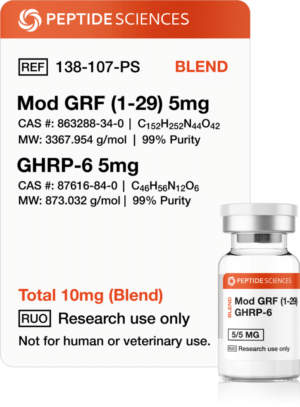
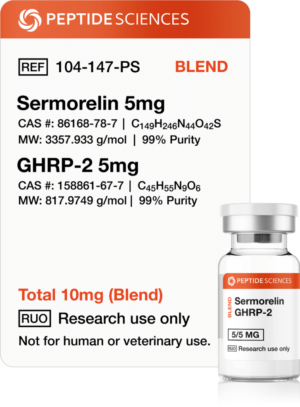
Mod GRF, GHRP-2 – Growth Hormone Signaling Research Peptide Combination
Mod GRF, GHRP-2 is a research peptide combination designed for laboratory investigations involving growth hormone–related signaling, peptide-receptor interactions, and endocrine pathway research. The formulation brings together two research compounds with different but complementary mechanisms of interest: a modified growth hormone-releasing hormone analog known as Mod GRF and the growth hormone secretagogue GHRP-2.
The scientific value of this combination comes from the distinct pathways associated with each peptide. Mod GRF is related to the growth hormone-releasing hormone family, while GHRP-2 belongs to the growth hormone secretagogue class. Researchers can therefore investigate how these signaling systems behave independently or in combination under controlled experimental conditions.
This product is intended as a laboratory research material. It should not be represented as an approved treatment, supplement, or product for human use.
Primary Research Classification
Mod GRF, GHRP-2 can be classified within peptide and endocrine signaling research.
Areas of scientific interest include:
- Growth hormone–related signaling
- GHRH receptor research
- Growth hormone secretagogue pathways
- Peptide-receptor interactions
- Intracellular signal transduction
- Hypothalamic-pituitary axis research
- Endocrine cell signaling
- Comparative secretagogue research
The two peptide components provide different molecular approaches for studying growth hormone–associated pathways.
Scientific Background
Mod GRF
Mod GRF is a modified analog of growth hormone-releasing hormone. GHRH is an endogenous hypothalamic peptide involved in the regulation of growth hormone secretion through interaction with the growth hormone-releasing hormone receptor (GHRHR) on pituitary somatotroph cells.
Research involving GHRH signaling commonly focuses on receptor activation and downstream intracellular pathways. Activation of GHRHR is associated with signaling processes involving cyclic AMP and protein kinase A, ultimately influencing cellular events associated with growth hormone secretion.
Modified GHRH analogs are of interest because structural changes to a peptide can alter properties such as stability, receptor interaction, and biological activity. The exact structure of the Mod GRF supplied in a particular product should always be confirmed using product-specific documentation.
GHRP-2
GHRP-2 is a synthetic growth hormone secretagogue that has been investigated for its interaction with the growth hormone secretagogue receptor (GHS-R). This receptor is also known as the ghrelin receptor and is part of the G protein-coupled receptor family.
GHRP-2 research has focused on its ability to activate signaling pathways associated with growth hormone secretion. Because GHRP-2 acts through a receptor system distinct from GHRHR, it provides researchers with a useful model for studying alternative secretagogue signaling.
Mechanism of Research Interest
The primary research interest in Mod GRF, GHRP-2 comes from the different receptor systems associated with its two components.
Mod GRF is associated with the GHRH receptor pathway. GHRH receptor activation can stimulate intracellular signaling involving cyclic AMP and protein kinase A. These pathways are important in regulating secretory activity within pituitary somatotroph cells.
GHRP-2, in contrast, interacts with GHS-R. GHS-R signaling involves G protein–mediated intracellular pathways and can influence calcium-dependent and other downstream signaling events.
Because these compounds engage different receptor systems, researchers may investigate questions such as:
- How do GHRHR and GHS-R signaling differ?
- How do distinct receptor pathways influence endocrine-cell activity?
- What intracellular signaling events follow peptide-receptor binding?
- How do structural differences between peptide analogs affect receptor interactions?
- What experimental conditions modify peptide-mediated signaling responses?
These questions are appropriate for controlled laboratory research and should not be interpreted as evidence of a therapeutic effect.
Molecular and Cellular Research
Peptide signaling depends heavily on molecular structure. Changes in amino-acid sequence, terminal modifications, peptide conformation, and stability can affect receptor recognition and activity.
For Mod GRF, researchers may examine the relationship between peptide structure and GHRHR interaction. For GHRP-2, studies can focus on ligand-receptor binding and downstream GHS-R signaling.
Potential experimental endpoints may include:
- Receptor activation
- Intracellular cyclic AMP signaling
- Calcium-associated signaling
- Protein kinase activity
- Gene-expression changes
- Secretory-cell responses
- Peptide stability
- Ligand-receptor interactions
The precise experimental response will depend on the model, assay design, peptide preparation, and analytical methodology.
Key Research Applications
1. GHRH Receptor Research
Mod GRF provides a research model for investigating GHRH receptor activity and downstream intracellular signaling. Researchers can study receptor-dependent responses under defined experimental conditions.
2. Growth Hormone Secretagogue Research
GHRP-2 is useful for studying GHS-R-mediated signaling. Experimental systems may examine receptor activation and associated intracellular responses.
3. Comparative Signaling Studies
Using two peptides with different receptor targets allows researchers to compare GHRHR and GHS-R signaling. Such work can help distinguish receptor-specific mechanisms from shared downstream effects.
4. Peptide-Receptor Interaction Studies
Researchers can examine how peptide structure influences receptor recognition, binding, and signaling. These studies may contribute to broader research into peptide pharmacology and receptor biology.
5. Endocrine Cell Models
Appropriate laboratory models can be used to investigate how peptide signaling affects endocrine-cell behavior. Such experiments require suitable controls and validated analytical methods.
6. Peptide Stability Research
Modified peptide structures can also be studied for physicochemical stability and behavior under defined laboratory conditions.
Technical Specifications
| Specification | Research Information |
|---|---|
| Product | Mod GRF, GHRP-2 |
| Product class | Research peptide combination |
| Primary research area | Growth hormone and endocrine signaling |
| Mod GRF target | Growth hormone-releasing hormone receptor (GHRHR) |
| GHRP-2 target | Growth hormone secretagogue receptor (GHS-R) |
| Peptide sequence | Product-specific information should be verified from applicable documentation |
| Molecular weight | Product-specific information should be verified from applicable documentation |
| Purity | Product-specific information should be verified from applicable Certificate of Analysis |
| Analytical testing | Product-specific information should be verified from applicable Certificate of Analysis |
| Formulation | Product-specific information should be verified from applicable product documentation |
Product-specific information should be verified from the applicable Certificate of Analysis or product documentation.
No assumptions should be made regarding molecular weight, purity, concentration, analytical testing, or formulation based solely on general information about Mod GRF or GHRP-2.
Storage and Handling
Peptide stability can depend on molecular structure, formulation, packaging, environmental exposure, and other product-specific factors. Researchers should therefore follow the storage and handling requirements supplied with the applicable product documentation.
General laboratory quality practices should include:
- Maintaining the original product container when practical.
- Limiting unnecessary exposure to environmental conditions.
- Avoiding contamination during laboratory handling.
- Following batch-specific documentation.
- Confirming product identity before experimental use.
- Reviewing the applicable Certificate of Analysis.
Specific storage temperatures and handling conditions should not be assumed without product-specific documentation.
Why Researchers Choose Peptide Sciences
Researchers evaluating Peptide Sciences products should focus on verifiable scientific attributes rather than unsupported performance claims.
Important considerations can include:
- Peptide identity
- Batch documentation
- Certificate of Analysis availability
- Analytical characterization
- HPLC analysis where applicable
- Mass spectrometry where applicable
- Formulation information
- Manufacturing documentation
Reliable documentation helps laboratories establish appropriate experimental controls and improve reproducibility.
Researchers searching for Peptide Science information may also encounter supplier reviews, online discussions, and promotional pages. These sources can provide context, but they should not replace batch-specific analytical documentation.
Likewise, searches for a peptide sciences promo code are commercial in nature and have no bearing on peptide identity, purity, receptor activity, stability, or scientific suitability. Promotional pricing should therefore be considered separately from technical evaluation.
Research Limitations and Evidence
Research involving Mod GRF and GHRP-2 should be interpreted according to the experimental model and available evidence.
Findings from biochemical assays, cultured cells, animal models, or other preclinical systems cannot automatically be translated into human outcomes. Differences in receptor expression, peptide metabolism, experimental conditions, and biological complexity can substantially influence results.
Researchers should distinguish between mechanistic evidence and demonstrated clinical efficacy. This product is presented strictly as a research material, and no therapeutic conclusions should be drawn from its inclusion in laboratory studies.
Laboratory Research Use Only
Mod GRF, GHRP-2 is intended for laboratory research use only.
It is not intended for human consumption, human administration, veterinary use, diagnosis, treatment, prevention, or cure of any disease or medical condition.
No human or animal dosing instructions are provided. Researchers are responsible for selecting appropriate experimental concentrations, controls, assay conditions, and safety procedures according to their institutional protocols and applicable regulations.
Conclusion
Mod GRF, GHRP-2 provides researchers with a useful peptide combination for investigating distinct growth hormone–associated signaling systems. Mod GRF is associated with GHRHR-mediated GHRH signaling, while GHRP-2 is associated with GHS-R-mediated secretagogue signaling.
This difference creates opportunities for comparative studies of receptor activity, intracellular signaling, peptide structure, endocrine-cell responses, and ligand-receptor interactions.
For laboratories evaluating Peptide Sciences research materials, product-specific documentation should remain the foundation of technical evaluation. Researchers may also encounter Peptide Science searches and a peptide sciences promo code when researching suppliers, but commercial information should never substitute for analytical documentation.
For Laboratory Research Use Only. Not for human or veterinary use. Not for diagnostic or therapeutic applications.