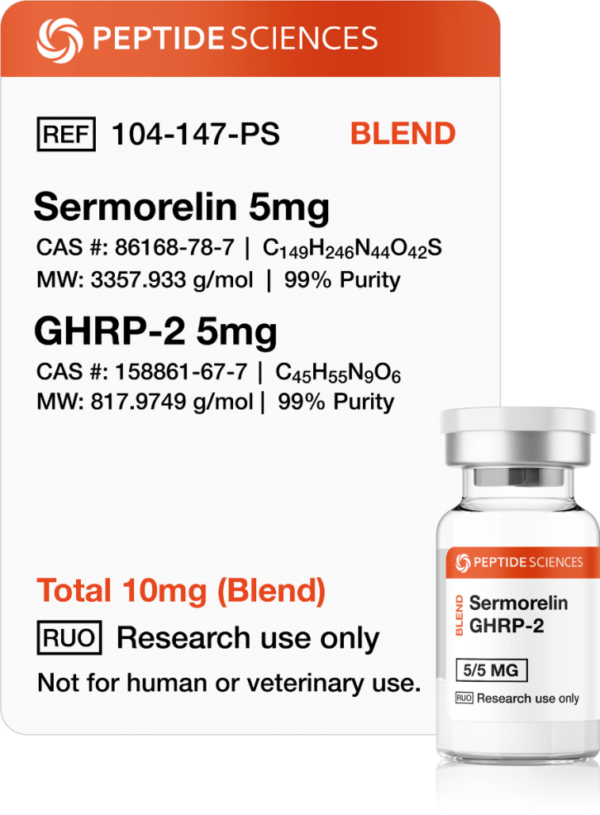
Sermorelin, GHRP-2 10mg (Blend)
The Sermorelin, GHRP-2 10mg (Blend) combines two research peptides associated with growth hormone regulation: Sermorelin and GHRP-2.
Although both compounds are studied in connection with growth hormone biology, they are structurally and pharmacologically distinct.
Sermorelin is a 29-amino-acid peptide corresponding to GHRH(1-29)-NH₂, the biologically active amino-terminal fragment of human growth hormone-releasing hormone. GHRP-2, also known as pralmorelin, is a synthetic hexapeptide growth hormone secretagogue.
The scientific interest in combining these peptides comes from their interaction with different components of the growth hormone regulatory system. Sermorelin primarily represents the GHRH receptor pathway, whereas GHRP-2 is associated with the growth hormone secretagogue receptor (GHS-R) pathway. Research has demonstrated that GHRP-2 can stimulate GH secretion through mechanisms that are not dependent entirely on an intact GHRH receptor pathway.
Primary Research Classification
The product can be classified as a growth hormone axis research peptide blend containing:
- Sermorelin — synthetic GHRH(1-29)-NH₂ peptide
- GHRP-2 — synthetic growth hormone secretagogue peptide
- GHRH/GHRH-receptor pathway research material
- GHS-R pharmacology research material
- Pituitary signaling research material
- Peptide structure-function research material
The two components should be evaluated independently when designing experiments because their molecular structures, receptor targets, and signaling characteristics differ.
Scientific Background: Sermorelin
Sermorelin represents the amino-terminal 29-residue region of human GHRH and contains a C-terminal amide. PubChem lists the sequence as:
YADAIFTNSYRKVLGQLSARKLLQDIMSR
Its molecular formula is C149H246N44O42S, with a reported molecular weight of approximately 3357.9 g/mol for the parent peptide.
Sermorelin is therefore considerably different from full-length human GHRH, which contains 44 amino acids. Its shorter structure represents the biologically active GHRH(1-29)-amide region and has been extensively investigated in studies of GHRH receptor biology.
From a molecular research perspective, Sermorelin provides a useful model for studying how a peptide ligand interacts with the growth hormone-releasing hormone receptor (GHRHR) and how receptor activation contributes to intracellular signaling within somatotroph cells.
Scientific Background: GHRP-2
GHRP-2, also called pralmorelin, is a synthetic hexapeptide with the sequence D-Ala-D-2Nal-Ala-Trp-D-Phe-Lys-NH₂. PubChem reports a molecular formula of C45H55N9O6 and a molecular weight of approximately 818.0 g/mol.
Unlike Sermorelin, GHRP-2 does not function as a GHRH analogue. It belongs to the growth hormone-releasing peptide family and is associated with activation of the growth hormone secretagogue receptor, also known as GHS-R.
The human GHS-R is a G protein-coupled receptor that participates in the neuroendocrine pathway regulating growth hormone release and is also associated with energy-homeostasis signaling.
This distinction is important when interpreting the blend: the two peptides provide different molecular entry points into growth hormone-related signaling.
Mechanism of Research Interest
Sermorelin and GHRH Receptor Signaling
Sermorelin is structurally related to endogenous GHRH and is studied for its interaction with the GHRH receptor.
GHRH receptor activation is associated with intracellular signaling involving adenylate cyclase and cyclic AMP (cAMP). In pituitary somatotroph models, GHRH receptor signaling can influence downstream pathways involved in growth hormone secretion.
Structure-activity research on GHRH(1-29)-NH₂ analogues has also demonstrated that peptide conformation, amphiphilicity, helicity, and specific residue interactions can influence receptor activation.
GHRP-2 and GHS-R Signaling
GHRP-2 acts through a different receptor system. Research identifies GHRP-2 as a synthetic agonist associated with the ghrelin/GHS-R pathway and growth hormone secretagogue activity.
The distinction between GHRH receptor signaling and GHS-R signaling is particularly useful for researchers studying how multiple endocrine signals converge on pituitary somatotroph function.
Experimental research has found that GHRP-2 can stimulate GH secretion even in subjects with mutations affecting the GHRH receptor, supporting the concept that GHRP-2 has a partially GHRH-independent mechanism.
Why the Combination Is Scientifically Interesting
The combination of Sermorelin and GHRP-2 creates a research model involving two different regulatory pathways.
Rather than treating the blend as a single molecular entity, researchers can examine:
- GHRH receptor signaling
- GHS-R signaling
- cAMP-mediated pathways
- Pituitary somatotroph activity
- Growth hormone secretory responses
- Receptor cross-talk
- Peptide-receptor interactions
- Structure-function relationships
- Endocrine signaling integration
Research in cultured pituitary cells has examined combined GHRH and GHRP-2 exposure and reported interactions between the two signaling systems, although findings can vary according to experimental conditions and model system.
Key Research Applications
1. GHRH Receptor Research
Sermorelin provides a defined peptide model for investigating GHRH receptor activation and the molecular features responsible for receptor recognition.
2. Growth Hormone Secretagogue Research
GHRP-2 is useful for research focused on the GHS-R and synthetic growth hormone secretagogue pharmacology.
3. Pituitary Cell Signaling
The blend may be investigated in experimental systems studying somatotroph signaling, intracellular second messengers, and endocrine peptide responses.
4. Receptor Cross-Talk
Because Sermorelin and GHRP-2 act through distinct receptor systems, the combination can be relevant to studies examining convergence between GHRH and GHS-R signaling.
5. Peptide Structure-Function Studies
Both peptides offer different structural models for examining how sequence, stereochemistry, terminal modifications, and receptor interactions influence biological activity.
6. Analytical Peptide Research
Sermorelin and related GHRH analogues have also been studied using chromatographic and mass-spectrometric techniques, including research into peptide metabolites and analytical detection.
Technical Specifications
| Specification | Sermorelin | GHRP-2 |
|---|---|---|
| Research classification | GHRH analogue | Growth hormone secretagogue peptide |
| Peptide length | 29 amino acids | 6 amino acids |
| Primary research target | GHRH receptor | GHS-R |
| Sequence | YADAIFTNSYRKVLGQLSARKLLQDIMSR | D-Ala-D-2Nal-Ala-Trp-D-Phe-Lys-NH₂ |
| Molecular formula | C149H246N44O42S | C45H55N9O6 |
| Approx. molecular weight | 3357.9 g/mol | 818.0 g/mol |
| CAS | 86168-78-7 | 158861-67-7 |
| Product format | Blend | Blend component |
Sermorelin molecular information is supported by PubChem, while GHRP-2 information is reported under pralmorelin.
Important: The listed product name indicates a 10mg blend, but the specific amount or ratio of Sermorelin versus GHRP-2 has not been provided. The individual component quantities should not be assumed.
Product-specific information should be verified from the applicable Certificate of Analysis or product documentation.
Storage and Handling
Storage requirements can depend on the specific formulation, packaging, manufacturing process, and batch specifications.
No product-specific storage conditions have been independently provided for this blend. Researchers should therefore rely on the applicable product documentation rather than applying generic storage assumptions.
Product-specific information should be verified from the applicable Certificate of Analysis or product documentation.
This description does not provide reconstitution procedures, administration instructions, dosing information, or instructions for human or animal use.
Why Researchers Choose Peptide Sciences
Researchers considering Sermorelin peptide sciences products should evaluate the specific material using objective, batch-level documentation.
Important verification points may include:
- Peptide identity
- Component composition
- Batch-specific documentation
- Certificate of Analysis availability
- Analytical characterization
- HPLC or MS data when provided
- Stated formulation
- Product-specific handling information
The presence of a recognized peptide name does not independently establish the identity, purity, concentration, or analytical quality of a particular commercial batch.
For this reason, researchers comparing Peptide Sciences with other research suppliers should focus on verifiable product documentation rather than unsupported general claims.
The phrase “sermorelin peptide sciences” may also appear in commercial searches, but search visibility and promotional language should not be confused with scientific validation. Researchers should always evaluate the actual documentation associated with the material being considered.
Research Evidence and Limitations
Sermorelin and GHRP-2 have been studied for decades in the context of growth hormone biology, but the two peptides should not be treated as interchangeable compounds.
Sermorelin primarily models GHRH-related signaling, while GHRP-2 represents a distinct growth hormone secretagogue mechanism associated with GHS-R. Experimental findings can vary according to species, cell type, receptor expression, assay design, exposure conditions, and other variables.
Research involving these compounds should therefore distinguish between direct receptor pharmacology, cellular signaling observations, animal studies, and human physiological data.
A blend also introduces an additional experimental variable: the relative proportion of each peptide. Without batch-specific composition data, the exact contribution of each component cannot be assumed.
Research-Use Disclaimer
Laboratory Research Use Only.
Sermorelin, GHRP-2 10mg (Blend) is presented for laboratory research and scientific investigation only. This product description does not provide medical advice, human or animal dosing instructions, treatment recommendations, administration instructions, or disease claims.
Researchers are responsible for determining whether the material is appropriate for their intended experimental application and for complying with applicable institutional, laboratory, safety, and regulatory requirements.