



Kisspeptin-10 Research Peptide
Kisspeptin-10 is a bioactive peptide fragment associated with the KISS1/KISS1R signaling system, an important pathway in neuroendocrine and reproductive biology research. It has become an important experimental tool for investigating the molecular communication between kisspeptin-producing neurons and the reproductive hormone axis.
Kisspeptin signaling is particularly notable because of its relationship with gonadotropin-releasing hormone (GnRH) neurons. Research has established the KISS1/KISS1R system as an important upstream component of reproductive neuroendocrine signaling.
For researchers, Kisspeptin-10 provides an opportunity to study peptide-receptor interactions, receptor-mediated signal transduction, neuroendocrine communication, and the regulation of reproductive signaling networks.
Primary Research Classification: Kisspeptin & Neuroendocrine Research
Kisspeptin-10 belongs to the kisspeptin peptide and neuroendocrine research category.
The KISS1 gene encodes a precursor protein known as preprokisspeptin, which can be processed into several kisspeptin peptides. These peptides share a biologically important C-terminal region that interacts with the kisspeptin receptor.
The principal receptor is KISS1R, also known as GPR54.
KISS1R is a G protein-coupled receptor expressed in tissues involved in neuroendocrine regulation. Its activation has been extensively investigated in relation to GnRH neuronal signaling and reproductive hormone regulation.
This makes Kisspeptin-10 particularly relevant to research involving:
- Kisspeptin receptor pharmacology
- GnRH neuronal signaling
- Reproductive neuroendocrinology
- GPCR signaling
- Hypothalamic signaling
- Puberty-related research
- Reproductive biology
- Peptide structure-activity relationships
Scientific Background
The KISS1/KISS1R system was initially studied in connection with tumor biology and later became recognized as an important regulator of reproductive neuroendocrine function.
Kisspeptin-producing neurons are found in specific regions of the hypothalamus and other areas of the central nervous system. These neurons communicate with components of the reproductive endocrine system through peptide signaling.
Kisspeptin signaling has been closely associated with GnRH neurons, which play a central role in regulating the release of reproductive gonadotropins.
The discovery of this signaling relationship helped establish kisspeptin as an important molecular link between neural signaling and reproductive endocrine function.
Kisspeptin-10 is therefore useful for experimental systems designed to investigate how a relatively short peptide can activate a receptor and influence complex downstream neuroendocrine pathways.
Molecular Structure of Kisspeptin-10
Kisspeptin-10 is a 10-amino-acid peptide fragment derived from the larger kisspeptin family.
Its sequence contains a biologically important C-terminal region that is highly conserved among kisspeptin peptides. The C-terminal portion is particularly important for interaction with KISS1R.
The peptide’s molecular structure allows researchers to investigate relationships between:
- Peptide sequence and receptor recognition
- C-terminal structure and receptor activation
- Peptide conformation
- Ligand-receptor interactions
- Structure-activity relationships
- Receptor-mediated cellular signaling
Because molecular characteristics can vary depending on formulation and product preparation, researchers should confirm product-specific specifications using the applicable documentation.
Mechanism of Research Interest
KISS1R Activation
The primary research target of Kisspeptin-10 is KISS1R/GPR54.
KISS1R belongs to the GPCR family. When activated by an appropriate kisspeptin ligand, the receptor can initiate intracellular signaling pathways.
This provides a useful experimental model for studying how extracellular peptide signals are converted into intracellular biochemical responses.
Gq/11-Associated Signaling
KISS1R signaling has been associated with Gq/11-mediated pathways.
Activation can stimulate phospholipase C (PLC), which influences intracellular signaling molecules and calcium dynamics.
A simplified representation of this research pathway is:
Kisspeptin-10 → KISS1R → G-protein signaling → PLC-associated signaling → intracellular calcium response
The magnitude and characteristics of the response can depend on receptor expression, cell type, experimental conditions, and the specific assay system.
GnRH-Related Signaling
One of the most significant areas of kisspeptin research involves its relationship with GnRH neurons.
Experimental studies have investigated how KISS1R activation influences GnRH neuronal activity and the subsequent reproductive endocrine signaling cascade.
This relationship makes Kisspeptin-10 a valuable research tool for studying communication between neural peptide systems and endocrine pathways.
Key Research Applications
KISS1R Receptor Research
Kisspeptin-10 can be used in laboratory research examining KISS1R expression, receptor activation, ligand-receptor interactions, and downstream signaling.
Researchers may compare different kisspeptin fragments to investigate receptor activity and structure-function relationships.
Neuroendocrine Research
The KISS1/KISS1R pathway provides an important model for investigating neuroendocrine communication.
Kisspeptin-10 can be studied in experimental systems exploring how hypothalamic peptide signaling interacts with reproductive endocrine pathways.
GnRH Signaling Research
Kisspeptin signaling has a close relationship with GnRH neuronal activity.
Laboratory studies can investigate this relationship using cellular, tissue, or other appropriate experimental models.
Reproductive Biology
The kisspeptin system has become an important area of reproductive biology research.
Researchers can examine how KISS1R activation relates to reproductive signaling networks and endocrine regulation.
GPCR Pharmacology
Because KISS1R is a GPCR, Kisspeptin-10 can also support broader research into receptor pharmacology, intracellular signal transduction, receptor activation, and ligand specificity.
Structure-Activity Research
Comparisons between Kisspeptin-10 and longer kisspeptin-derived peptides can help researchers investigate how peptide length and sequence affect receptor interaction.
Kisspeptin-10 and the Reproductive Axis
The reproductive endocrine system involves communication between the hypothalamus, pituitary gland, and gonadal tissues.
Kisspeptin signaling is considered an important upstream component of this network because of its relationship with GnRH neurons.
A simplified research framework is:
KISS1/Kisspeptin → KISS1R → GnRH signaling → gonadotropin signaling
This pathway is considerably more complex in biological systems and is influenced by multiple feedback mechanisms, hormones, neural signals, and metabolic factors.
For research purposes, Kisspeptin-10 allows scientists to investigate one component of this broader regulatory network without treating the pathway as a single linear mechanism.
Technical Specifications
| Specification | Details |
|---|---|
| Product Name | Kisspeptin-10 |
| Peptide Class | Kisspeptin / neuroendocrine peptide |
| Primary Research Target | KISS1R / GPR54 |
| Primary Research Area | Neuroendocrine and reproductive signaling |
| Peptide Length | 10 amino acids |
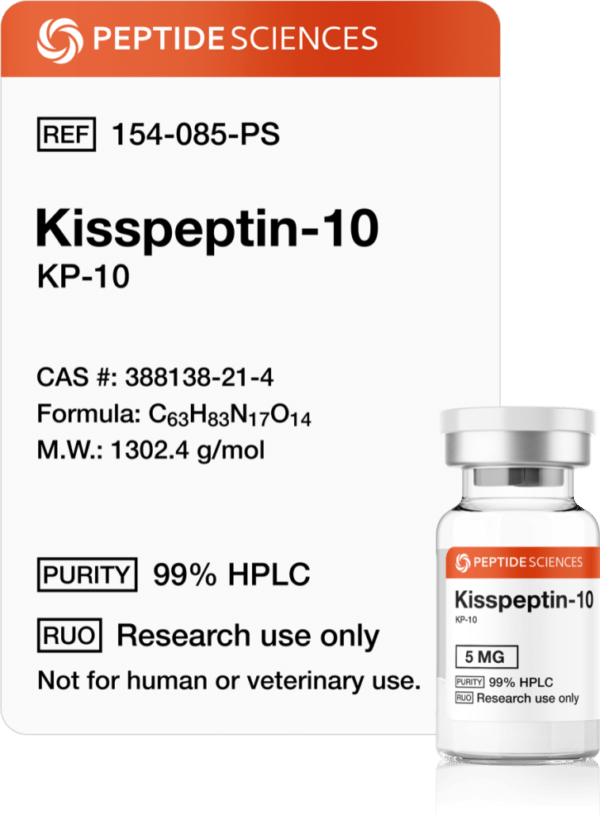
| Quantity | Product-specific information should be verified from applicable documentation. |
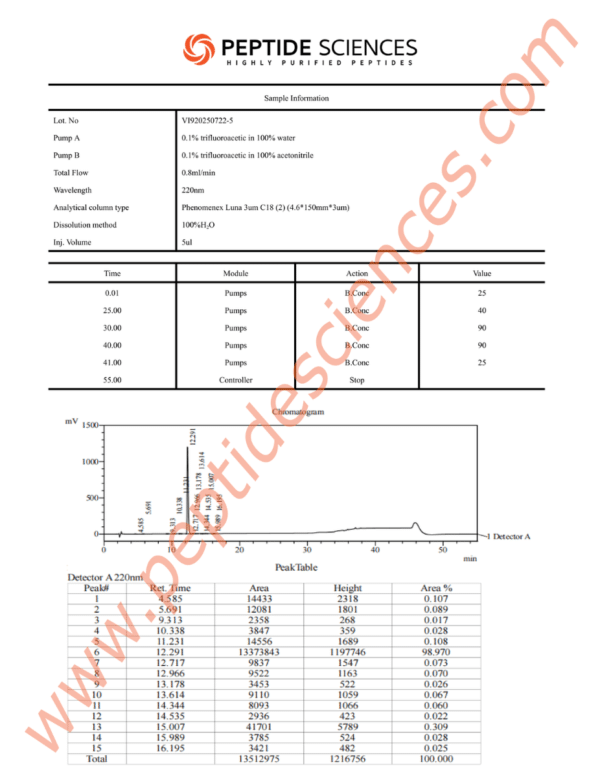
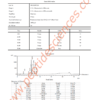
| Purity | Product-specific information should be verified from the applicable Certificate of Analysis or product documentation. |
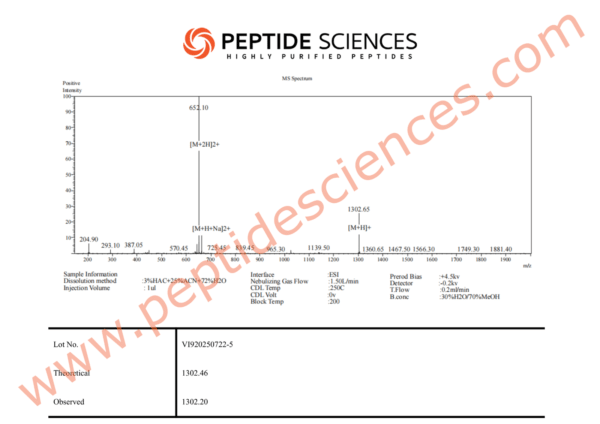
| Molecular Weight | Product-specific information should be verified from the applicable Certificate of Analysis or product documentation. |
| Analytical Testing | Product-specific information should be verified from the applicable Certificate of Analysis or product documentation. |
| Formulation | Product-specific information should be verified from applicable product documentation. |
| Storage | Follow the product-specific storage and handling documentation. |
Product Documentation
Researchers should always consult the current product documentation and applicable Certificate of Analysis (COA) for batch-specific information. General scientific information should not be substituted for product-specific analytical documentation.
Storage and Handling
Kisspeptin-10 should be handled according to the storage and handling requirements specified in the applicable product documentation.
Peptides can be affected by factors including temperature, moisture, light, formulation, and storage duration. Appropriate laboratory handling procedures should therefore be followed throughout storage and experimental preparation.
Where product-specific instructions are available, those instructions should take precedence over generalized recommendations.
Laboratory personnel should follow institutional safety procedures and all applicable requirements for research materials.
No human or veterinary administration instructions are provided.
Why Researchers Choose Peptide Sciences
When evaluating Peptide Sciences products, researchers should focus on verifiable information associated with the specific product and manufacturing batch.
Relevant considerations may include:
- Peptide identity
- Batch-specific purity information
- Analytical characterization
- Certificate of Analysis availability
- Product quantity
- Formulation information
- Storage requirements
- Documentation supporting laboratory research use
Researchers looking for Peptide Science materials should verify current product specifications before incorporating a peptide into an experimental protocol.
Likewise, searches for a peptide sciences promo code should be checked against current official promotional information because discounts, eligibility, and availability may change.
The appropriate product should ultimately be selected according to the requirements of the research model and laboratory protocol.
Laboratory Research Use Disclaimer
For Laboratory Research Use Only.
Kisspeptin-10 is intended for laboratory research, analytical, educational, and experimental applications. It is not intended for human or veterinary administration, self-administration, diagnosis, treatment, mitigation, or prevention of any disease or medical condition.
The information presented on this page is provided for scientific and research purposes only and should not be interpreted as medical advice or a recommendation for human use.
Researchers are responsible for determining the suitability of the material for their particular experimental system and for complying with applicable laws, institutional policies, and laboratory safety requirements.
Experimental findings should be interpreted according to the model, methodology, receptor system, and experimental conditions used. Results observed in cellular or animal research should not automatically be interpreted as equivalent outcomes in humans.