Gonadorelin Research Peptide – Peptide Sciences
Gonadorelin is a synthetic decapeptide corresponding to gonadotropin-releasing hormone (GnRH), one of the principal signaling peptides involved in reproductive neuroendocrine regulation. It is widely studied as a molecular tool for investigating the communication between the hypothalamus and the reproductive endocrine system.
The biological importance of GnRH comes from its interaction with the GnRH receptor (GnRHR), a G protein-coupled receptor expressed on gonadotroph cells of the anterior pituitary. Activation of this receptor initiates intracellular signaling pathways that influence the synthesis and release of the gonadotropins luteinizing hormone (LH) and follicle-stimulating hormone (FSH).
For laboratory researchers, Gonadorelin provides a useful experimental ligand for studying receptor activation, peptide signaling, endocrine communication, and the regulation of reproductive pathways.
Primary Research Classification: GnRH & Reproductive Neuroendocrine Research
Gonadorelin belongs to the gonadotropin-releasing hormone and reproductive neuroendocrine research category.
GnRH is produced by specialized neurons in the hypothalamus. These neurons release GnRH into the hypothalamic-pituitary portal circulation, allowing the peptide to communicate with GnRHR-expressing cells in the pituitary.
The resulting signaling cascade is an important component of the hypothalamic-pituitary-gonadal (HPG) axis.
Research involving Gonadorelin can therefore intersect several scientific areas, including:
- GnRH receptor pharmacology
- Reproductive endocrinology
- Neuroendocrine signaling
- GPCR research
- Pituitary cell signaling
- LH and FSH regulation
- Peptide-receptor interactions
- Structure-activity relationship studies
Scientific Background
Gonadorelin is the synthetic form of naturally occurring GnRH, a decapeptide produced by hypothalamic neurons.
GnRH represents an important connection between neural signaling and endocrine regulation. Rather than acting as a conventional circulating hormone produced by a peripheral endocrine gland, GnRH originates within the hypothalamus and communicates with the pituitary through a specialized neuroendocrine pathway.
The mature GnRH peptide consists of ten amino acids and contains structural features that contribute to receptor recognition and biological activity.
One of the defining characteristics of GnRH biology is its pulsatile signaling pattern. Experimental research has demonstrated that the frequency and pattern of GnRH signaling can influence downstream gonadotropin responses.
This makes Gonadorelin especially useful in research examining how peptide signaling dynamics influence endocrine systems.
Molecular Structure of Gonadorelin
Gonadorelin is a decapeptide, meaning it contains ten amino acid residues.
The peptide has a highly conserved structure that allows it to interact with the GnRH receptor. Structural features at both ends of the peptide contribute to receptor recognition and signaling activity.
The sequence of native GnRH is commonly represented as:
pGlu-His-Trp-Ser-Tyr-Gly-Leu-Arg-Pro-Gly-NH₂
This molecular arrangement provides a useful framework for investigating peptide structure and receptor activation.
Researchers can study how modifications to the GnRH structure influence:
- Receptor affinity
- Receptor activation
- Peptide stability
- Signal duration
- Receptor selectivity
- Intracellular signaling
- Structure-activity relationships
Product-specific analytical characteristics should always be verified through the applicable Certificate of Analysis and current product documentation.
Mechanism of Research Interest
GnRH Receptor Activation
The primary molecular target of Gonadorelin is the GnRH receptor (GnRHR).
GnRHR is a member of the GPCR superfamily. When Gonadorelin interacts with the receptor, it can induce a receptor conformational change that initiates intracellular signaling.
This provides researchers with a model for studying how a peptide ligand activates a membrane-bound receptor and produces a downstream cellular response.
Gq/11 and Phospholipase C Signaling
GnRHR signaling is strongly associated with Gq/11-mediated pathways.
Following receptor activation, signaling can involve phospholipase C (PLC). PLC activity contributes to the production of intracellular signaling molecules, including inositol trisphosphate (IP₃) and diacylglycerol (DAG).
These signaling molecules can influence intracellular calcium dynamics and protein kinase pathways.
A simplified research pathway can be represented as:
Gonadorelin → GnRHR → Gq/11 → PLC → IP₃/DAG → intracellular signaling
The exact cellular response depends on receptor expression, cell type, experimental conditions, and signaling context.
Pulsatile GnRH Signaling
An important feature of GnRH biology is that the peptide is naturally released in a pulsatile pattern.
This temporal pattern is significant because different signaling frequencies can produce different downstream endocrine responses.
Researchers can therefore use GnRH-related experimental systems to examine:
- Pulse frequency
- Receptor desensitization
- Signal duration
- Gonadotropin regulation
- Receptor internalization
- Intracellular signaling dynamics
Understanding temporal signaling is particularly important when studying neuroendocrine systems because biological responses cannot always be explained by ligand concentration alone.
Key Research Applications
GnRH Receptor Research
Gonadorelin can be studied as a ligand for investigating GnRHR activity.
Experimental systems may examine receptor expression, receptor activation, ligand-receptor interactions, and downstream signal transduction.
Reproductive Endocrinology
Gonadorelin is relevant to laboratory research investigating the molecular regulation of the reproductive endocrine system.
Researchers can study how GnRH signaling interacts with pituitary gonadotroph cells and downstream endocrine pathways.
LH and FSH Signaling Research
GnRH receptor activation is closely associated with the regulation of LH and FSH secretion.
Research models can examine the cellular mechanisms connecting GnRH receptor activation with gonadotropin production and release.
GPCR Pharmacology
Because GnRHR is a GPCR, Gonadorelin can be incorporated into broader studies of receptor pharmacology.
Potential research areas include receptor activation, intracellular signaling, receptor regulation, and ligand-receptor interactions.
Peptide Structure-Activity Research
Gonadorelin’s defined peptide sequence makes it useful for investigating how changes in amino acid composition or terminal modifications affect receptor interactions.
Comparative studies with GnRH analogues can provide insight into peptide stability, receptor affinity, and signaling behavior.
Neuroendocrine Signaling
Gonadorelin provides a model for examining communication between the nervous and endocrine systems.
This includes research into hypothalamic signaling, pituitary responses, and the broader HPG axis.
Gonadorelin and the HPG Axis
The hypothalamic-pituitary-gonadal axis is a complex communication network connecting the brain, pituitary gland, and gonadal tissues.
A simplified research model is:
Hypothalamic GnRH → GnRH receptor → LH/FSH signaling → gonadal endocrine pathways
This pathway is regulated by multiple feedback mechanisms and is influenced by numerous endocrine, metabolic, and neural signals.
Gonadorelin allows researchers to investigate the GnRH component of this larger system.
Importantly, experimental observations should always be interpreted within the context of the specific research model rather than treating the HPG axis as a simple linear pathway.
Technical Specifications
| Specification | Details |
|---|---|
| Product Name | Gonadorelin |
| Alternative Name | Gonadotropin-Releasing Hormone (GnRH) |
| Peptide Class | Synthetic decapeptide |
| Primary Research Target | GnRH receptor (GnRHR) |
| Receptor Family | G protein-coupled receptor |
| Primary Research Area | Reproductive neuroendocrinology |
| Peptide Length | 10 amino acids |
| Sequence | pGlu-His-Trp-Ser-Tyr-Gly-Leu-Arg-Pro-Gly-NH₂ |
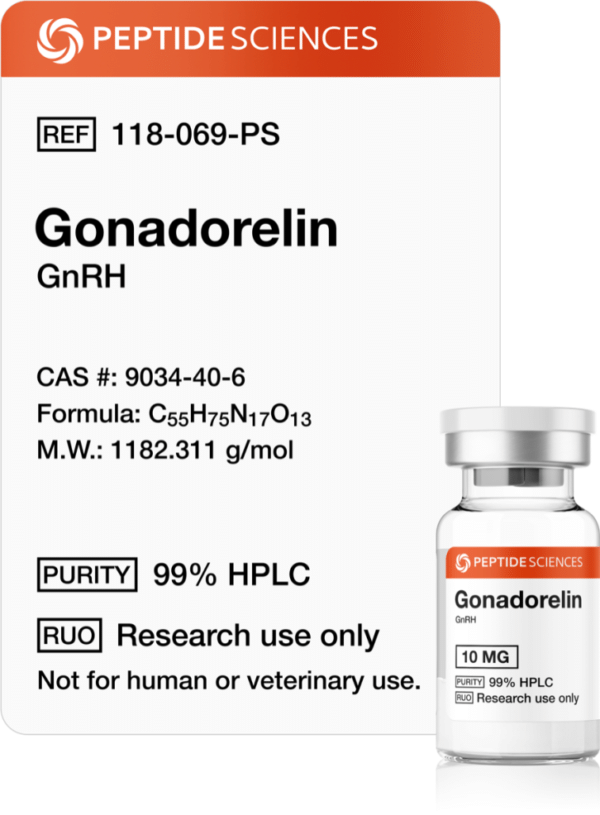
| Quantity | Product-specific information should be verified from applicable documentation. |
| Purity | Product-specific information should be verified from the applicable Certificate of Analysis or product documentation. |
| Molecular Weight | Product-specific information should be verified from the applicable Certificate of Analysis or product documentation. |
| Analytical Testing | Product-specific information should be verified from the applicable Certificate of Analysis or product documentation. |
| Formulation | Product-specific information should be verified from applicable product documentation. |
| Storage | Follow the product-specific storage and handling documentation. |
Product Documentation
Researchers should consult the current product documentation and applicable Certificate of Analysis (COA) for batch-specific specifications.
General scientific information should not be substituted for product-specific analytical documentation.
Storage and Handling
Gonadorelin should be handled according to the storage and handling requirements supplied with the applicable product.
Peptides can be affected by environmental conditions such as temperature, moisture, light exposure, formulation, and storage duration.
Researchers should therefore follow product-specific instructions whenever they are available.
Laboratory personnel should also follow institutional safety procedures and applicable requirements governing research materials.
No human or veterinary administration instructions are provided.
Why Researchers Choose Peptide Sciences
When evaluating Peptide Sciences as a source of research peptides, researchers should focus on verifiable characteristics associated with the specific product and batch.
Relevant considerations can include:
- Peptide identity
- Purity information
- Analytical characterization
- Batch documentation
- Certificate of Analysis availability
- Product quantity
- Formulation details
- Storage requirements
Researchers searching for Peptide Science products should review current product documentation before selecting a material for an experimental protocol.
Likewise, anyone conducting a peptide science review should distinguish independently reported experiences or opinions from verified analytical and product information.
Product selection should ultimately be based on the requirements of the experimental system and the documentation available for the specific material.
Laboratory Research Use Disclaimer
For Laboratory Research Use Only.
Gonadorelin is intended for laboratory research, analytical, educational, and experimental applications. It is not intended for human or veterinary administration, self-administration, diagnosis, treatment, mitigation, or prevention of any disease or medical condition.
The information presented on this page is provided for scientific and research purposes only and should not be interpreted as medical advice or a recommendation for human use.
Researchers are responsible for determining the suitability of the material for their specific experimental system and for complying with applicable laws, institutional policies, and laboratory safety requirements.
Experimental results should be interpreted according to the biological model, methodology, receptor system, and experimental conditions used.