PT-141 Research Peptide – 2mg
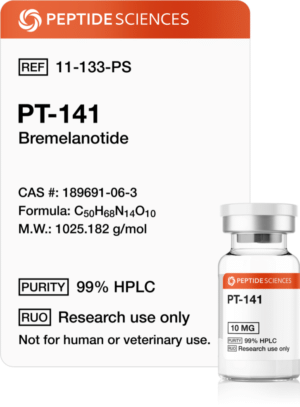
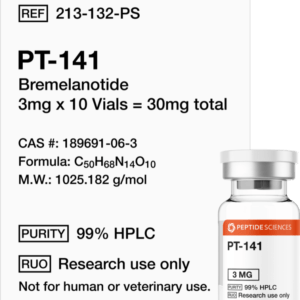
PT-141, also known as bremelanotide, is a synthetic cyclic peptide derived from the melanocortin peptide family. It is primarily studied as an agonist of melanocortin receptors, with research focusing particularly on MC3R and MC4R signaling.
Melanocortin receptors are a family of G protein-coupled receptors involved in a broad range of biological processes. Depending on receptor subtype and tissue distribution, melanocortin signaling has been investigated in areas including neural activity, energy balance, pigmentation, cardiovascular regulation, and sexual behavior.
PT-141 is especially interesting to peptide researchers because its biological activity is associated with melanocortin receptor signaling rather than simply functioning as a conventional peripheral vasodilator.
Primary Research Classification: Melanocortin Receptor Agonist
PT-141 is classified as a melanocortin receptor agonist.
The melanocortin receptor family contains five known receptor subtypes: MC1R, MC2R, MC3R, MC4R, and MC5R. These receptors have different tissue distributions and biological roles.
PT-141 has demonstrated activity at several melanocortin receptors, with MC3R and MC4R considered particularly relevant to research into its central effects.
This makes PT-141 useful for investigating:
- Melanocortin receptor pharmacology
- GPCR signaling
- MC3R and MC4R activity
- Central nervous system signaling
- Peptide structure-activity relationships
- Neural and behavioral research
- Energy-balance pathways
The biological response to PT-141 can vary according to receptor subtype, experimental system, species, and exposure conditions.
Scientific Background
The melanocortin system is an important signaling network involving peptide hormones derived from proopiomelanocortin (POMC).
POMC-derived peptides include several biologically active melanocortins, including α-melanocyte-stimulating hormone (α-MSH).
These peptides interact with melanocortin receptors located in different tissues.
Melanocortin signaling is involved in diverse biological functions. MC1R, for example, is strongly associated with pigmentation and immune-related processes, while MC2R is primarily associated with adrenocorticotropic hormone signaling in the adrenal cortex.
MC3R and MC4R have attracted considerable research interest because of their roles within the central nervous system and their involvement in energy homeostasis and other neural processes.
PT-141 provides researchers with a synthetic ligand for examining these receptor systems in controlled experimental environments.
Molecular Characteristics
PT-141 is a cyclic heptapeptide analogue derived from melanocortin-related peptide structures.
Its cyclic structure contributes to the molecular characteristics that distinguish it from linear peptide sequences.
Peptide structure can influence:
- Receptor binding
- Receptor selectivity
- Molecular stability
- Conformational behavior
- Biological activity
The relationship between peptide structure and receptor activity makes PT-141 relevant to structure-activity relationship (SAR) research.
Researchers studying PT-141 should use product-specific analytical documentation to confirm the identity, purity, formulation, and other characteristics of the material under investigation.
Mechanism of Research Interest
Melanocortin Receptor Activation
PT-141 interacts with melanocortin receptors, which belong to the G protein-coupled receptor (GPCR) family.
When an agonist binds to a GPCR, the receptor can undergo a conformational change that initiates intracellular signaling.
The downstream response depends on the receptor subtype, cellular environment, and experimental conditions.
MC3R and MC4R Signaling
MC3R and MC4R are particularly relevant to research surrounding PT-141.
These receptors are expressed within the central nervous system and have been investigated in relation to energy balance, feeding behavior, reproductive signaling, and neural activity.
Experimental studies can use PT-141 to investigate how activation of these receptors influences downstream cellular and behavioral responses.
Central Neural Signaling
One distinguishing feature of PT-141 research is its relationship with central melanocortin pathways.
Experimental research has explored how melanocortin receptor activation can influence neural circuits associated with motivated behavior and physiological regulation.
This provides a useful framework for studying peptide-mediated signaling within the nervous system.
Key Research Applications
Melanocortin Receptor Research
PT-141 can be used as a research ligand for investigating melanocortin receptor pharmacology.
Researchers can examine receptor activation, ligand-receptor interactions, and downstream signaling responses in appropriate experimental systems.
GPCR Pharmacology
Because melanocortin receptors are GPCRs, PT-141 is relevant to broader research into GPCR structure, activation, desensitization, and intracellular signaling.
Structure-Activity Relationship Studies
The cyclic structure of PT-141 provides opportunities for investigating how peptide conformation affects receptor binding and biological activity.
Researchers may compare PT-141 with related melanocortin peptides or analogues to examine differences in receptor activity.
Neural Signaling Research
PT-141 can be investigated in experimental models examining central melanocortin pathways and their relationship to neural signaling.
Behavioral Research
Melanocortin receptor pathways have been studied in experimental models of motivated behavior and reproductive signaling. PT-141 may therefore serve as a research tool for investigating these pathways.
Such findings should be interpreted according to the specific experimental model and should not automatically be extrapolated to humans.
PT-141 and Melanocortin Biology
PT-141 belongs to a broader research area involving melanocortin peptides and their receptors.
Related molecules include α-MSH and other melanocortin analogues. However, these compounds can differ substantially in receptor affinity, selectivity, stability, and biological activity.
Researchers should therefore avoid assuming that findings involving one melanocortin peptide necessarily apply to PT-141.
This distinction is especially important when comparing experimental results across different receptor systems or animal and cellular models.
Technical Specifications
| Specification | Information |
|---|---|
| Product Name | PT-141 2mg |
| Alternative Name | Bremelanotide |
| Peptide Class | Synthetic cyclic peptide |
| Research Classification | Melanocortin receptor agonist |
| Primary Research Targets | Melanocortin receptors, particularly MC3R/MC4R |
| Quantity | 2mg |
| Purity | Product-specific information should be verified from the applicable Certificate of Analysis or product documentation. |
| Analytical Testing | Product-specific information should be verified from the applicable Certificate of Analysis or product documentation. |
| Molecular Information | Verify current product documentation. |
| Storage | Follow the product-specific storage instructions and applicable product documentation. |
Why Researchers Choose Peptide Sciences
High-quality peptide research depends on accurately characterized experimental materials.
Researchers evaluating PT-141 from Peptide Sciences should consider product-specific characteristics such as peptide identity, analytical purity, batch documentation, formulation, and available testing.
Peptidesciences research materials should be evaluated using the documentation associated with the specific product and batch.
Where a Certificate of Analysis is provided, researchers can use it to review relevant analytical information before incorporating the material into laboratory research.
Important considerations may include:
- Peptide identity
- Purity and analytical characterization
- Batch-specific documentation
- Product quantity
- Formulation information
- Storage requirements
These factors can help laboratories establish appropriate controls and maintain consistency across experiments.
Storage and Handling
Peptide stability can be affected by temperature, moisture, light exposure, formulation, packaging, and storage duration.
Researchers should follow the specific storage and handling instructions provided for the PT-141 2mg product. Where available, the applicable Certificate of Analysis and manufacturer documentation should be treated as the primary reference for product-specific requirements.
Laboratory personnel should handle PT-141 according to institutional safety procedures and all applicable regulations.
Avoid relying on generalized storage recommendations when product-specific instructions are available.
Laboratory Research Use Disclaimer
For Laboratory Research Use Only.
PT-141 2mg is provided for laboratory research, analytical, and educational purposes. It is not intended for human or veterinary administration, self-administration, diagnosis, treatment, mitigation, or prevention of any disease or medical condition.
No information on this page should be interpreted as medical advice or as a recommendation for human use.
Researchers are responsible for complying with applicable laws, regulations, institutional requirements, and laboratory safety procedures.
Experimental findings should be interpreted according to the specific peptide, biological model, methodology, and experimental conditions used.