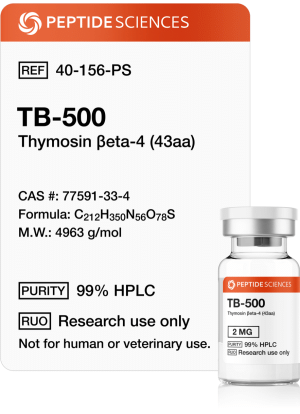
TB-500 (Thymosin Beta-4) Research Peptide
TB-500 (Thymosin Beta-4) is a peptide associated with research into Thymosin Beta-4, a 43-amino-acid peptide that occurs naturally in many mammalian tissues and cell types. It has become an area of interest in molecular biology because of its relationship with actin regulation and several cellular processes involving migration, organization, and tissue remodeling.
The scientific literature surrounding Thymosin Beta-4 includes investigations into cell migration, angiogenesis, extracellular matrix regulation, inflammation-related signaling, and cellular responses to injury. Much of this work has been conducted using experimental models, so findings should not automatically be interpreted as evidence of established therapeutic effects in humans.
For researchers evaluating TB-500 (Thymosin Beta-4), understanding the distinction between the native peptide, experimental analogs, and commercial research formulations is important. Product identity and formulation should therefore be confirmed using batch-specific documentation.
Primary Research Classification
TB-500 (Thymosin Beta-4) can be categorized within research involving:
- Peptide biology
- Cytoskeletal regulation
- Actin-associated signaling
- Cell migration
- Cellular remodeling
- Angiogenesis research
- Extracellular matrix biology
- Tissue-related cellular responses
This classification describes areas of scientific investigation and does not represent a medical indication.
Scientific Background
Thymosin Beta-4 is a small peptide composed of 43 amino acids. One of its best-characterized biological relationships is its interaction with G-actin, the globular form of actin.
Actin is a fundamental component of the cytoskeleton. It contributes to cell structure, intracellular transport, adhesion, and movement. Because cellular migration requires coordinated changes in the actin cytoskeleton, compounds that influence actin availability and organization can be important research tools for studying cellular movement.
Thymosin Beta-4 has been investigated as an actin-sequestering peptide. By interacting with actin, it can influence the balance between different pools of actin within cells. This provides one scientific basis for continued research into its effects on cellular dynamics.
The peptide has also been investigated in experimental models involving vascular signaling and cellular responses associated with tissue remodeling. However, the mechanisms are complex and may involve multiple signaling pathways rather than a single receptor-mediated action.
Molecular Structure and Mechanism of Research Interest
A key feature of Thymosin Beta-4 research is its relationship with the actin cytoskeleton.
Unlike many signaling peptides that primarily exert their effects by binding to a specific cell-surface receptor, Thymosin Beta-4 is strongly associated with intracellular actin regulation. Its interaction with G-actin can affect the availability and organization of actin within cells.
This is particularly relevant to research involving:
- Cytoskeletal organization
- Cellular motility
- Cell spreading
- Migration-related processes
- Vascular cell behavior
- Extracellular matrix interactions
Experimental research has also examined associations between Thymosin Beta-4 and signaling pathways involving proteins such as AKT, ERK, and other regulators of cell survival, migration, and growth. These findings remain an area of active investigation, and pathway activity can vary according to cell type and experimental conditions.
Researchers studying TB-500 should therefore consider the peptide within the broader context of cytoskeletal biology and cellular signaling rather than treating it as a single-pathway reagent.
Key Research Applications
1. Actin and Cytoskeletal Research
Actin dynamics are central to cell shape, adhesion, movement, and division. Thymosin Beta-4 provides a useful research subject for examining how peptide interactions can influence actin availability and cytoskeletal behavior.
Researchers may investigate changes in actin organization using appropriate cellular and biochemical models.
2. Cell Migration Studies
Cell migration is an important biological process involved in development, immune responses, vascular biology, and tissue remodeling.
Because Thymosin Beta-4 has been associated with actin regulation, researchers have investigated its relationship with cellular migration and movement.
3. Angiogenesis Research
Experimental studies have examined Thymosin Beta-4 in relation to angiogenic processes, including endothelial cell behavior and vascular development.
These studies have generated interest in signaling mechanisms involving endothelial cells, extracellular matrix interactions, and vascular growth pathways. Results should be interpreted within the limitations of the experimental model.
4. Tissue Remodeling Research
Thymosin Beta-4 has also been studied in experimental systems involving tissue remodeling and cellular responses following injury.
Researchers may examine changes in cellular migration, extracellular matrix organization, vascular signaling, and related molecular markers.
5. Cellular Signaling Research
The peptide has been investigated in connection with several signaling pathways associated with cell survival, migration, and growth. These include pathways involving kinases and transcriptional regulators.
Such research can help investigators explore how cytoskeletal regulation interacts with broader intracellular signaling networks.
Technical Specifications
| Property | Information |
|---|---|
| Product | TB-500 (Thymosin Beta-4) |
| Peptide association | Thymosin Beta-4 |
| Native Thymosin Beta-4 length | 43 amino acids |
| Research classification | Peptide research / cytoskeletal biology |
| Intended use | Laboratory Research Use Only |
| Purity | Product-specific information should be verified from the applicable Certificate of Analysis or product documentation. |
| Molecular weight | Product-specific information should be verified from the applicable Certificate of Analysis or product documentation. |
| Analytical testing | Product-specific information should be verified from the applicable Certificate of Analysis or product documentation. |
| Formulation | Product-specific information should be verified from the applicable product documentation. |
| Batch information | Verify the applicable Certificate of Analysis. |
The term TB-500 is used commercially in connection with Thymosin Beta-4-related research materials, but researchers should not assume that every TB-500 product is chemically identical to the full native 43-amino-acid Thymosin Beta-4 sequence. Product-specific identity should always be confirmed through appropriate documentation.
Storage and Handling
Proper storage and handling depend on the specific formulation, packaging, and manufacturing specifications of the research material.
Because no product-specific storage parameters have been provided here, researchers should follow the instructions supplied with the applicable product documentation.
Product-specific information should be verified from the applicable Certificate of Analysis or product documentation.
General laboratory practices should include appropriate labeling, controlled handling, protection from contamination, and adherence to institutional laboratory procedures.
No human or animal administration instructions are provided for this research product.
Why Researchers Choose Peptide Sciences
Researchers evaluating a peptide supplier typically need reliable information about product identity, analytical characterization, batch documentation, and quality controls.
Peptide Sciences can serve as a professional source for researchers seeking peptide materials when the relevant product documentation supports the required specifications.
Researchers considering TB-500 (Thymosin Beta-4) may evaluate factors such as:
- Peptide identity
- Batch-specific documentation
- Certificate of Analysis availability
- Analytical characterization
- HPLC or mass-spectrometry data, when provided
- Stated purity specifications
- Formulation information
- Packaging and handling documentation
These attributes should be evaluated on a product- and batch-specific basis rather than assumed across an entire catalog.
Researchers conducting a Peptide Science review should also distinguish between documented product characteristics and claims made by third-party sources. Independent literature can help establish scientific context, while the applicable Certificate of Analysis is the appropriate source for batch-specific analytical information.
Searchers may also encounter queries such as “peptide science discount code” when comparing peptide suppliers online. Promotional information should be treated separately from scientific quality. A discount or promotional offer does not establish peptide identity, purity, analytical performance, or suitability for a particular research protocol.
Research Considerations and Scientific Limitations
Research involving Thymosin Beta-4 and TB-500 remains an evolving field. Experimental findings may differ based on peptide identity, model organism, cell type, formulation, concentration, experimental conditions, and study design.
Some reported biological effects have been observed in cellular or animal models and should not be presented as established human therapeutic outcomes.
In particular, researchers should avoid assuming that findings associated with native Thymosin Beta-4 necessarily apply in exactly the same way to every material marketed as TB-500.
Careful experimental design and appropriate analytical controls remain important when studying peptide activity.
Related Research Areas
TB-500 (Thymosin Beta-4) may be relevant to research involving:
- Thymosin Beta-4
- Actin biology
- Cytoskeletal dynamics
- Cell migration
- Angiogenesis
- Extracellular matrix research
- Cellular signaling
- Tissue remodeling
- Peptide biochemistry
These related areas can provide useful context when developing a broader research program involving peptide-mediated cellular processes.
Laboratory Research Use Only
TB-500 (Thymosin Beta-4) is presented for laboratory research use only. It is not intended to diagnose, treat, cure, mitigate, or prevent any disease or medical condition.
This product description does not provide instructions for human or animal administration, dosing, or therapeutic use. Researchers are responsible for complying with applicable laws, institutional requirements, laboratory safety procedures, and ethical standards.
Scientific evidence should be evaluated critically, particularly where findings originate from preliminary, cellular, or animal research.