P21 (P021) for Laboratory Research
P21 (P021) is a small neurotrophic peptide mimetic derived from research into the biologically active region of ciliary neurotrophic factor (CNTF). It was designed to retain relevant neurotrophic activity while incorporating structural modifications intended to improve its pharmacological properties.
Unlike full-length CNTF, which is a larger protein, P021 is a short synthetic peptidergic compound. Published literature describes P021 as a modified form of the CNTF-derived sequence that incorporates an adamantylated glycine residue. This modification was investigated to improve characteristics such as resistance to enzymatic degradation and movement across the blood-brain barrier.
P021 has attracted research interest because studies in experimental systems have associated it with neurogenesis, neuronal differentiation, synaptic plasticity, and increased BDNF expression. These findings remain primarily preclinical and should not be interpreted as evidence of established human therapeutic efficacy.
Primary Research Classification
P21 (P021) can be classified within several related areas of laboratory research:
- Neurotrophic peptide research
- Neurogenesis research
- Neural progenitor cell biology
- Synaptic plasticity research
- Neurobiology
- Peptide pharmacology
- BDNF signaling research
- LIF/JAK-STAT signaling research
- Experimental cognitive neuroscience
Its strongest scientific identity is as a CNTF-derived neurotrophic peptide mimetic investigated in models of neuronal development, neurogenesis, and brain plasticity.
Scientific Background
Ciliary neurotrophic factor is a member of the neuropoietic cytokine family and has been studied for its role in neuronal survival, differentiation, and neurogenesis. However, the properties of full-length neurotrophic proteins can create challenges for experimental development, including limited tissue penetration and pharmacokinetic limitations.
P021 was developed through research designed to identify a smaller active region of CNTF. Earlier work identified a neurogenic peptide sequence from CNTF, which was subsequently reduced to a shorter active fragment. The resulting compound, P021, incorporated an adamantylated glycine modification. Published studies describe P021 as Ac-DGGLᴬG-NH₂, with the modification contributing to its experimental stability and permeability characteristics.
This molecular design makes P021 useful as a research tool for examining how small peptide mimetics can reproduce selected biological activities associated with larger neurotrophic factors.
Molecular Structure and Characteristics
Published scientific literature identifies P021 as a modified pentapeptide derived from an active region of human CNTF. Its reported structure is:
Ac-DGGLᴬG-NH₂
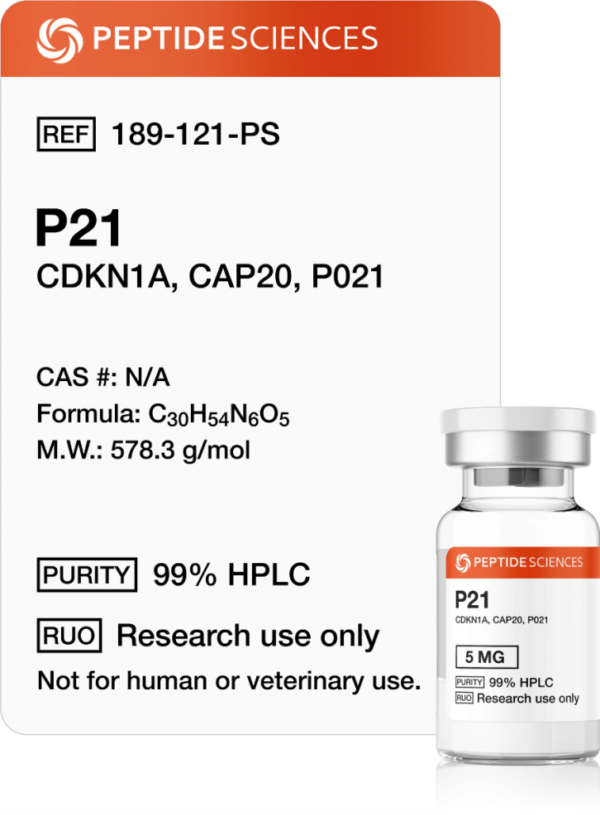
The superscripted residue represents the adamantylated glycine modification incorporated into the compound. The published literature reports a molecular weight of approximately 578.3 Da for this research compound.
These published structural details describe the research compound itself and should not automatically be assumed to represent the specifications of every commercially supplied P21 (P021) preparation.
For commercial product specifications, including current batch identity, purity, analytical results, and formulation details:
Product-specific information should be verified from the applicable Certificate of Analysis or product documentation.
Mechanism of Research Interest
P021 is particularly interesting because research has associated its activity with several interconnected neurotrophic pathways.
LIF Signaling
One proposed mechanism involves modulation of leukemia inhibitory factor (LIF) signaling. LIF belongs to a family of cytokine signaling systems involved in cellular differentiation and neural biology.
Experimental literature has reported that P021 can competitively inhibit aspects of LIF signaling. This mechanism has been investigated as part of the compound’s effects on neural progenitor activity and neurotrophic responses.
BDNF Expression
Another major area of interest is brain-derived neurotrophic factor (BDNF).
Preclinical research has reported increased BDNF transcription and expression following P021 exposure. BDNF is an important neurotrophic signaling molecule involved in neuronal survival, differentiation, synaptic plasticity, and neural network function.
The relationship between P021 and BDNF makes the compound particularly relevant to laboratory studies examining how neurotrophic signaling can influence neuronal plasticity.
CREB and Downstream Signaling
Research has also examined changes in CREB activity and downstream signaling associated with P021. BDNF-related signaling can interact with pathways involving TrkB, PI3K/Akt, and other intracellular signaling networks.
Some animal studies have reported effects on GSK-3β activity and tau phosphorylation. These findings remain experimental and should be interpreted within the specific model and study conditions in which they were observed.
Key Research Applications
P21 (P021) may be investigated in laboratory models involving:
Neurogenesis
Researchers have examined P021 in relation to the formation and maturation of neural progenitor cells. Studies have reported increased neurogenesis in experimental animal models following P021 exposure.
Synaptic Plasticity
P021 has also been studied in connection with markers associated with synaptic function and neuronal plasticity. Published animal research has reported changes in synaptic and dendritic markers following treatment with the compound.
Neurotrophic Signaling
The relationship between P021, LIF signaling, and BDNF expression makes it useful for investigating molecular pathways involved in neurotrophic support.
Experimental Aging Research
Researchers have investigated P021 in animal models of cognitive aging. These studies have explored relationships between neurogenesis, BDNF expression, synaptic markers, and behavioral outcomes.
Neurological Disease Models
P021 has been evaluated in several preclinical models involving neurological and neurodevelopmental conditions, including experimental models of Alzheimer’s disease and Down syndrome. More recent research has also examined the compound in models of CDKL5 deficiency.
Importantly, these studies do not establish P021 as an approved treatment for any of these conditions.
Research Evidence and Limitations
The existing literature surrounding P021 is primarily preclinical. Much of the evidence comes from cultured cells and animal models.
For example, studies in transgenic mouse models have reported changes in neurogenesis, synaptic markers, cognitive performance, and disease-associated molecular pathways.
These findings are scientifically interesting but have important limitations:
- Animal findings cannot automatically be extrapolated to humans.
- Cellular responses depend on experimental conditions.
- Changes in biomarkers do not necessarily establish clinical benefit.
- Long-term safety and efficacy in humans remain separate questions.
- Different formulations or preparations may have different analytical characteristics.
Researchers should therefore evaluate P021 according to the specific experimental question, model, assay, and available analytical documentation.
Technical Specifications
| Specification | Information |
|---|---|
| Product Name | P21 (P021) |
| Research Classification | Neurotrophic peptide mimetic |
| Parent Molecule | Ciliary neurotrophic factor (CNTF) |
| Reported Structure | Ac-DGGLᴬG-NH₂ |
| Reported Molecular Weight | Approximately 578.3 Da |
| Research Targets/Pathways | LIF signaling, BDNF-related signaling |
| Research Areas | Neurogenesis, neuronal plasticity, neurobiology |
| Product Purity | Verify applicable product documentation |
| Batch Information | Verify applicable Certificate of Analysis |
| Analytical Testing | Verify applicable product documentation |
| Formulation | Product-specific information should be verified |
| Storage | Follow applicable product documentation |
Published research provides structural information about P021, but commercial product attributes should always be confirmed against the documentation supplied with the specific batch.
Storage and Handling
Storage conditions should be determined from the specific product documentation supplied for the material.
Researchers should:
- Follow the manufacturer’s stated storage conditions.
- Keep the material properly labeled.
- Protect the research material from unsuitable environmental exposure.
- Use appropriate laboratory handling procedures.
- Consult the applicable Certificate of Analysis or product documentation for stability information.
Product-specific information should be verified from the applicable Certificate of Analysis or product documentation.
No human or animal administration instructions are provided.
Why Researchers Choose Peptide Sciences
Researchers selecting P21 (P021) should evaluate the product using objective, batch-specific information rather than unsupported performance claims.
Peptide Sciences provides a commercial source for research-oriented peptide materials, while researchers should independently review the documentation associated with the specific product.
Relevant quality considerations may include:
- Peptide identity
- Batch documentation
- Analytical characterization
- Certificate of Analysis availability
- Purity information
- Formulation details
- Applicable testing documentation
The scientific literature provides a useful foundation for understanding P21 (P021), but published research should not be confused with the quality specifications of a particular commercial batch.
Researchers searching for Peptide Science resources may also encounter information about peptide structure, neurotrophic signaling, and experimental applications. These terms describe areas of scientific investigation and do not establish clinical efficacy.
Similarly, searches for peptide sciences may include supplier comparisons, product information, and laboratory research resources. Researchers should prioritize primary scientific literature and batch-specific analytical documentation when evaluating a research material.
Peptide Science and Research Documentation
The term Peptide Science encompasses a broad field involving peptide structure, molecular interactions, receptor biology, pharmacology, and cellular signaling. P21 (P021) is particularly relevant to this field because its development illustrates how a short peptide mimetic can be designed from a biologically active region of a larger neurotrophic protein.
For researchers, the most useful evaluation combines published scientific evidence with product-specific documentation. A peptide sciences supplier page can provide commercial information, but the experimental suitability of a material should ultimately be determined through appropriate analytical records and laboratory validation.
Important Research-Use Disclaimer
P21 (P021) is intended for laboratory research use only.
This product is not intended for human consumption, self-administration, diagnosis, treatment, cure, mitigation, or prevention of disease. Research findings involving P021 should not be presented as evidence of an approved medical use.
Any references to Alzheimer’s disease, cognitive function, neurodevelopment, neurogenesis, or other biological outcomes describe areas in which P021 has been investigated experimentally. They do not constitute medical claims or recommendations.
Researchers are responsible for following applicable institutional, regulatory, safety, and laboratory requirements.