Semax 30mg – Synthetic Heptapeptide for Neurobiology Research
Semax 30mg is a synthetic heptapeptide studied extensively in experimental neurobiology. The molecule consists of the four-amino-acid sequence corresponding to ACTH(4–7) followed by a C-terminal Pro-Gly-Pro (PGP) sequence.
The complete sequence is:
Met-Glu-His-Phe-Pro-Gly-Pro
or:
MEHFPGP
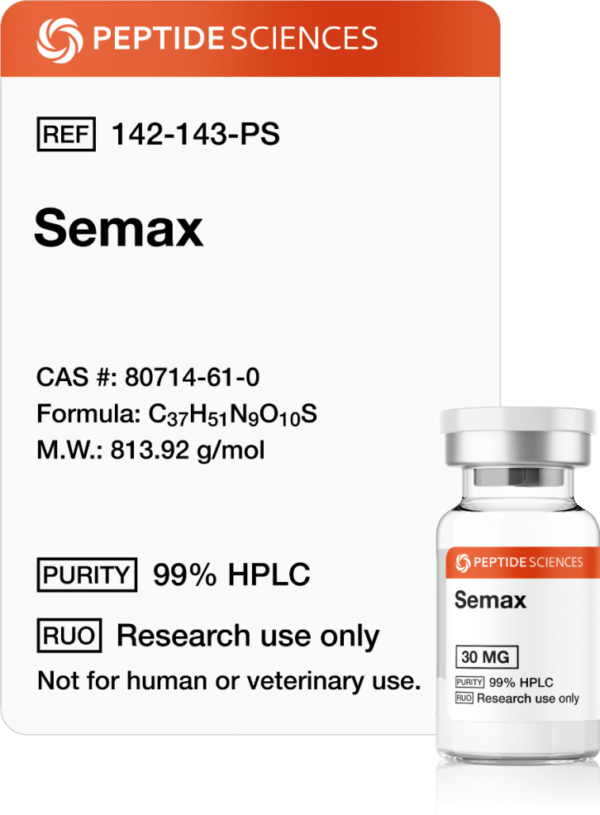
PubChem lists Semax under the chemical name ACTH (4–7), Pro-Gly-Pro, with a molecular formula of C₃₇H₅₁N₉O₁₀S and molecular weight of approximately 813.9 g/mol. The compound is listed under CAS 80714-61-0.
Semax is scientifically distinct from the full-length adrenocorticotropic hormone (ACTH). It should also not be described as identical to the natural ACTH(4–10) sequence. The research compound consists of the ACTH(4–7) segment plus the synthetic Pro-Gly-Pro extension.
Primary Research Classification
Semax can be classified as:
- Synthetic heptapeptide
- ACTH(4–7)-derived peptide
- Neurobiology research peptide
- Neurotrophin research compound
- Peptide signaling research tool
- Neuroimmune research peptide
- Experimental cognitive and neuronal signaling compound
The peptide has attracted particular interest because experimental studies suggest effects on molecular pathways associated with BDNF, NGF, neurotransmission, neuronal plasticity, and inflammatory signaling.
Scientific Background
Semax was developed as a synthetic peptide based on a short region of ACTH. Researchers modified the ACTH-derived sequence by adding the Pro-Gly-Pro tripeptide.
This structural modification is important because it changes the biological properties of the parent fragment. Scientific literature commonly describes Semax as an analogue of an ACTH fragment with reported neurotropic activity.
The peptide’s research history has largely focused on nervous-system biology. Investigators have examined its effects on gene expression, neurotrophic factors, neurotransmitter systems, and responses to experimental neurological injury.
Because these effects involve multiple biological pathways, Semax is better understood as a multifunctional experimental peptide model than as a simple single-receptor agonist.
Molecular Structure and Technical Specifications
| Specification | Information |
|---|---|
| Product | Semax 30mg |
| Classification | Synthetic heptapeptide |
| Sequence | MEHFPGP |
| Full sequence | Met-Glu-His-Phe-Pro-Gly-Pro |
| Related structure | ACTH(4–7) + Pro-Gly-Pro |
| Molecular Formula | C₃₇H₅₁N₉O₁₀S |
| Molecular Weight | 813.9 g/mol |
| CAS Number | 80714-61-0 |
| Product Quantity | 30mg |
| Primary Research Areas | Neurobiology, neurotrophins, peptide signaling |
The molecular information above comes from the public PubChem record.
The 30mg product quantity is separate from the molecular weight of an individual Semax molecule.
Product-specific information should be verified from the applicable Certificate of Analysis or product documentation.
Purity, analytical testing, HPLC/MS results, formulation, salt form, and other batch-specific characteristics should not be assumed unless documented for the applicable product.
Mechanism of Research Interest
One of the most important areas of Semax research involves neurotrophin signaling.
Neurotrophins are proteins that support neuronal survival, differentiation, connectivity, and synaptic plasticity. Two particularly important neurotrophins investigated in Semax research are BDNF and NGF.
BDNF Signaling
Brain-derived neurotrophic factor, or BDNF, plays an important role in neuronal plasticity and synaptic function.
A published study found that Semax increased BDNF protein levels in the rat basal forebrain following experimental administration. The researchers also identified specific, reversible binding of radiolabeled Semax to membrane preparations from this brain region.
These observations provide a basis for investigating whether Semax can influence neurotrophic signaling through specific molecular interactions.
Importantly, the precise receptor or molecular target responsible for all of Semax’s biological effects has not been definitively established.
NGF and Neurotrophin Gene Expression
Research has also examined nerve growth factor (NGF) and BDNF gene expression following exposure to Semax.
In cultured rat glial cells, investigators reported changes in BDNF and NGF messenger RNA after Semax treatment.
Other animal studies reported changes in BDNF and NGF expression in regions including the hippocampus and frontal cortex.
These findings make Semax relevant to research examining the relationship between peptide signaling and neurotrophic gene regulation.
GABAergic and Neurotransmitter Research
Semax has also been investigated in relation to neurotransmitter systems, including GABAergic signaling.
GABA is the principal inhibitory neurotransmitter in the central nervous system. Researchers studying Semax have investigated whether the peptide can influence the expression or regulation of genes associated with GABA receptors and neurotransmission.
The evidence does not support reducing Semax to a conventional direct GABA receptor agonist. Instead, the research suggests broader modulation of molecular pathways involved in neuronal signaling.
This distinction is important when designing experiments and interpreting published findings.
Neuroimmune and Inflammatory Research
Another research area involves interactions between nervous-system signaling and immune-related pathways.
Experimental studies have examined changes in cytokine-related signaling and inflammatory gene expression following Semax exposure. These findings have contributed to interest in Semax as a potential research model for studying neuroimmune communication.
The relationship between peptide signaling, neurotrophins, cytokines, and neuronal responses remains complex. Results may vary depending on the experimental model, tissue, timing, and analytical method.
Key Research Applications
1. Neurotrophin Research
Semax can be investigated in experimental systems examining BDNF and NGF expression, neurotrophic signaling, and related molecular pathways.
2. Neuroplasticity Research
Because BDNF and related signaling pathways are central to neuronal plasticity, Semax provides a peptide model for investigating molecular mechanisms associated with neuronal adaptation.
3. Gene-Expression Studies
Researchers have examined rapid changes in neurotrophin-related gene expression following Semax exposure. These studies can help investigate peptide regulation of transcriptional pathways.
4. Neuroimmune Research
Semax can be included in experimental studies examining communication between neural and immune signaling pathways.
5. Peptide Structure–Activity Research
The defined MEHFPGP sequence makes Semax useful for studying how modifications to short peptide structures influence biological activity and enzymatic stability.
6. Experimental Neurological Research
Preclinical literature has examined Semax in models involving neurological stress and experimental brain injury. These studies remain model-specific and should not be interpreted as proof of clinical efficacy.
Enzymatic Stability and Peptide Design
The Pro-Gly-Pro extension is an important feature of Semax’s molecular design.
Short peptide fragments can be susceptible to enzymatic degradation. The addition of the PGP sequence was intended to modify the biological properties and stability of the ACTH-derived peptide.
This makes Semax useful in peptide-engineering research focused on the relationship between sequence design, proteolytic stability, biological persistence, and signaling activity.
Researchers can therefore study Semax not only as a neurobiology compound but also as an example of how structural modification can alter the properties of a peptide-derived molecule.
Research Evidence and Limitations
The scientific literature surrounding Semax includes biochemical investigations, cellular experiments, gene-expression studies, and animal research.
Several PubMed-indexed studies report effects involving BDNF, NGF, neurotrophin receptors, and neuronal signaling. For example, experimental work in rat models has reported increased expression of BDNF, NGF, and related neurotrophic pathways following Semax exposure.
However, the evidence base is not uniform. Many mechanistic findings originate from cell and animal models, and the complete molecular mechanism of Semax remains incompletely understood.
Researchers should therefore distinguish between:
- Observed experimental effects
- Proposed molecular mechanisms
- Preclinical findings
- Established clinical evidence
This distinction is essential for scientifically responsible product content and research interpretation.
For researchers comparing Peptide Science products, published evidence and product-specific documentation should be evaluated separately. A well-characterized research material does not automatically establish a biological or therapeutic outcome.
Storage and Handling
Storage requirements depend on the specific product formulation, packaging, manufacturing process, and batch documentation.
No specific storage temperature, shelf life, solvent, reconstitution condition, or handling procedure should be assumed unless it is documented for the applicable product.
Product-specific information should be verified from the applicable Certificate of Analysis or product documentation.
Researchers should follow institutional laboratory procedures, applicable safety requirements, and the documentation supplied with the research material.
Why Researchers Choose Peptide Sciences
Researchers evaluating Semax 30mg from Peptide Science should focus on verifiable product characteristics rather than unsupported claims.
Potential evaluation criteria include:
- Correct peptide identity
- Expected amino-acid sequence
- Molecular characterization
- Stated product quantity
- Lot-specific documentation
- Certificate of Analysis availability
- Analytical testing, where documented
- Formulation information, where applicable
The phrase “peptide sciences” may be used broadly when researchers compare peptide suppliers and scientific resources. However, supplier-specific quality claims should always be supported by applicable product documentation.
Product-specific information should be verified from the applicable Certificate of Analysis or product documentation.
Laboratory Research Use Only
Semax 30mg is intended for laboratory research use only. It is not intended for human consumption, veterinary use, diagnosis, treatment, prevention, or mitigation of any disease or medical condition.
No human or animal dosing instructions are provided. Experimental findings from cellular and animal models should not be interpreted as evidence of established human safety or therapeutic efficacy.
Researchers should review applicable institutional procedures, regulatory requirements, safety information, and product-specific analytical documentation before conducting laboratory work.