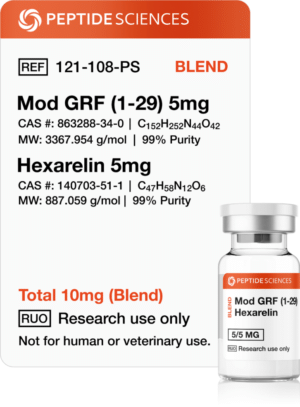
Mod GRF, Ipamorelin 10mg Research Peptide
GRF, Ipamorelin 10mg combines two peptide compounds that are studied within the broader field of growth hormone and endocrine signaling research.
Mod GRF is a modified analog related to growth hormone–releasing hormone. Ipamorelin is a synthetic peptide belonging to the growth hormone secretagogue class. Their research interest comes from their association with separate but interconnected signaling systems involved in growth hormone regulation.
Studying these compounds together may provide researchers with an experimental framework for examining receptor signaling, intracellular communication, pituitary responses, and interactions between different regulatory pathways.
The product is intended to be discussed and evaluated strictly as a laboratory research material. Scientific descriptions of receptor activity or biological mechanisms should not be interpreted as claims of clinical safety or therapeutic effectiveness.
Primary Research Classification
Mod GRF, Ipamorelin 10mg falls within several areas of peptide and endocrine research:
- Growth hormone signaling research
- GHRH receptor research
- Growth hormone secretagogue research
- GHS-R receptor studies
- Peptide-receptor interaction research
- Pituitary cell signaling
- Intracellular signal transduction
- Endocrine pathway research
- Peptide structure-activity studies
The combination is particularly relevant to researchers studying the relationship between GHRH-associated signaling and secretagogue-mediated signaling.
Scientific Background
Growth hormone regulation involves multiple signaling systems operating across the hypothalamus, pituitary gland, and peripheral tissues.
Growth hormone–releasing hormone is an important regulator of pituitary growth hormone secretion. Mod GRF is a modified GHRH analog used in experimental research involving this pathway. Structural modifications to peptide molecules can influence receptor recognition, molecular stability, and other biochemical characteristics.
Ipamorelin is a synthetic growth hormone secretagogue. Research involving this peptide has focused on signaling through the growth hormone secretagogue receptor, commonly known as GHS-R.
GHS-R is a G-protein-coupled receptor involved in intracellular signaling. Ligand-receptor interactions can initiate downstream signaling events that researchers may examine using biochemical, cellular, or physiological models.
Because Mod GRF and Ipamorelin are associated with different receptor systems, their combination can be useful for experimental studies investigating the relationship between these signaling pathways.
Mechanism of Research Interest
Mod GRF and GHRH Signaling
Mod GRF is studied in relation to the GHRH receptor. Researchers may investigate how receptor engagement influences intracellular signaling within experimental pituitary models.
GHRH receptor signaling involves G-protein-mediated intracellular pathways and downstream second-messenger activity. The precise response depends on the experimental model and receptor environment.
Ipamorelin and Secretagogue Signaling
Ipamorelin belongs to the growth hormone secretagogue class and is studied in connection with GHS-R.
Research can examine how peptide-receptor binding influences intracellular signaling and downstream cellular activity. The characteristics of this signaling can differ according to the receptor system, experimental conditions, and biological model.
Combined Signaling Research
The combination creates an opportunity to investigate interactions between two distinct regulatory pathways.
Potential research areas include:
- GHRH receptor activity
- GHS-R receptor activity
- Peptide-receptor recognition
- Intracellular second-messenger signaling
- Pituitary cellular responses
- Signaling pathway convergence
- Structure-activity relationships
- Comparative endocrine signaling
These mechanisms remain dependent on experimental conditions and should not be presented as predictable outcomes in humans.
Key Research Applications
Growth Hormone Signaling
Researchers can investigate how GHRH-related and secretagogue-related pathways contribute to growth hormone-associated cellular responses.
Receptor-Ligand Research
Mod GRF and Ipamorelin offer distinct molecular systems for examining peptide-receptor interactions and receptor-mediated signaling.
Pituitary Cell Studies
Experimental cellular models can be used to study signaling events associated with pituitary somatotroph activity.
Signal Transduction
Researchers may examine intracellular pathways activated following receptor interaction, including second-messenger systems and downstream regulatory proteins.
Structure-Activity Research
Differences in peptide sequence and molecular structure can be evaluated to better understand receptor recognition and biological activity.
Technical Specifications
| Specification | Information |
|---|---|
| Product | Mod GRF, Ipamorelin 10mg |
| Research classification | GHRH analog / growth hormone secretagogue |
| Listed quantity | 10mg |
| Peptide identity | Product-specific information should be verified |
| Molecular weight | Product-specific information should be verified |
| Molecular formula | Product-specific information should be verified |
| Purity | Product-specific information should be verified |
| Analytical testing | Product-specific information should be verified |
| COA | Product-specific information should be verified |
| Formulation | Product-specific information should be verified |
No unsupported molecular formula, molecular weight, purity percentage, analytical result, or formulation characteristic should be assigned to the product.
Product-specific information should be verified from the applicable Certificate of Analysis or product documentation.
Storage and Handling
Peptide stability may depend on molecular structure, formulation, moisture exposure, temperature, light, packaging, and handling conditions. For this reason, storage specifications should be taken directly from the documentation associated with the applicable product and batch.
Researchers should follow appropriate laboratory handling procedures and institutional safety requirements.
Product-specific information should be verified from the applicable Certificate of Analysis or product documentation.
Peptide Science and Research Context
Peptide Science is a broad scientific field covering peptide chemistry, molecular structure, receptor recognition, protein interactions, cellular signaling, and biological activity.
Mod GRF and Ipamorelin are relevant to Peptide Science because their experimental study involves peptide-receptor interactions and signaling pathways associated with endocrine regulation.
Researchers evaluating these compounds should distinguish established biochemical principles from experimental hypotheses. Results from one experimental model may not necessarily reproduce in another system because receptor expression, peptide stability, cellular environment, and assay methodology can all affect observed activity.
Evaluating Peptide Sciences Research Materials
When conducting a peptide sciences review, researchers should prioritize objective and verifiable information.
Useful evaluation criteria include:
- Confirmed peptide identity
- Batch-specific Certificate of Analysis
- Analytical characterization
- Documented purity
- Formulation information
- Product traceability
- Relevant quality documentation
A thoughtful peptide sciences review should distinguish documented product characteristics from general promotional statements. Scientific literature should likewise be evaluated according to study methodology, experimental controls, biological model, and quality of evidence.
Any claim involving purity, HPLC, mass spectrometry, stability, peptide identity, or formulation should be verified against current product-specific documentation.
Why Researchers May Evaluate Peptide Sciences
Peptide Sciences can be evaluated as a research-material source based on the availability of documented information relevant to laboratory studies.
Researchers may consider factors such as peptide identity, batch documentation, analytical characterization, and supporting quality records when selecting research materials.
These attributes can help laboratories establish appropriate experimental controls and support reproducibility. However, supplier descriptions should not replace independent evaluation of primary scientific literature or batch-specific analytical documentation.
Research Limitations
Research involving growth hormone signaling peptides has several important limitations.
Experimental responses can vary according to:
- Cell type
- Species
- Receptor expression
- Peptide integrity
- Experimental conditions
- Assay methodology
- Biological environment
- Study design
Results observed in an isolated cellular system cannot automatically be extrapolated to a complete organism. Likewise, findings from animal models cannot automatically establish human biological or therapeutic outcomes.
Researchers should assess primary literature carefully and consider experimental controls, statistical methods, biological relevance, and study limitations before drawing conclusions.
Laboratory Research Use Only
Mod GRF, Ipamorelin 10mg is presented strictly for laboratory and scientific research. The information on this page is not medical advice and does not establish the safety, efficacy, or suitability of these compounds for human or veterinary use.
No human or animal administration instructions are provided. Researchers are responsible for following applicable institutional policies, laboratory safety procedures, ethical standards, and regulatory requirements.