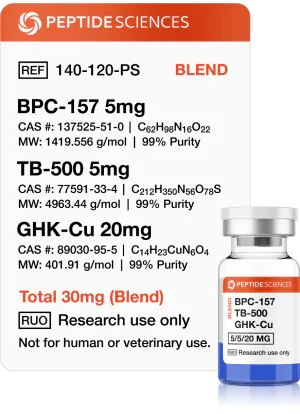


BPC-157, TB-500, GHK-Cu 30mg for Laboratory Research
BPC-157, TB-500, GHK-Cu 30mg combines three distinct peptide research materials with different molecular characteristics and biological research profiles. Studying them together can provide a broader experimental framework for investigating cellular communication, tissue-response pathways, vascular biology, extracellular matrix activity, and other interconnected mechanisms.
BPC-157 has received substantial attention in preclinical research. Published studies have investigated pathways involving nitric oxide signaling, vascular responses, fibroblast activity, and tissue repair. However, the current evidence remains heavily weighted toward laboratory and animal research, while human clinical evidence remains limited. Recent reviews also highlight unresolved questions involving pharmacokinetics, formulation, safety, and translation into clinical applications.
TB-500 is commonly used as a research designation associated with thymosin beta-4-related peptide research. Thymosin beta-4 itself is a naturally occurring 43-amino-acid peptide that binds G-actin and influences actin polymerization dynamics. Research has connected thymosin beta-4 biology with cell migration, angiogenesis, inflammatory signaling, and tissue remodeling. Importantly, TB-500 should not automatically be treated as chemically identical to full-length thymosin beta-4; researchers should verify the exact sequence and characterization of the material being studied.
GHK-Cu represents the copper-associated form of glycyl-L-histidyl-L-lysine. GHK has a high affinity for copper and has been studied in connection with extracellular matrix remodeling, inflammatory processes, antioxidant activity, and tissue biology.
Together, these three research materials provide multiple experimental avenues for examining complex biological processes without assuming that observations from one peptide apply automatically to the others.
Primary Research Classification
| Peptide | Primary research area | Key biological interest |
|---|---|---|
| BPC-157 | Peptide and tissue-response research | Vascular signaling, cellular migration, inflammatory pathways |
| TB-500 | Thymosin beta-4-related research | Actin dynamics, cell migration, angiogenesis, tissue remodeling |
| GHK-Cu | Copper-peptide research | Extracellular matrix biology, inflammatory signaling, remodeling |
| Combination | Multi-peptide research | Interactions among signaling and tissue-response pathways |
Product-specific information should be verified from the applicable Certificate of Analysis or product documentation.
Scientific Background: BPC-157
BPC-157, or Body Protection Compound-157, is a synthetic pentadecapeptide that has been extensively investigated in preclinical research. Its reported sequence is commonly represented as GEPPPGKPADDAGLV. Studies have examined its effects across several biological systems, including gastrointestinal, vascular, musculoskeletal, and inflammatory models.
Research interest in BPC-157 includes its relationship with nitric oxide signaling and vascular pathways. Some studies have proposed interactions involving VEGFR2 and the Akt-eNOS axis, which are important components of angiogenic and endothelial signaling. Experimental work has also examined fibroblast activity and microvascular responses.
Despite extensive preclinical interest, BPC-157 has not established the clinical evidence required to support broad therapeutic claims. A recent review noted that its pharmaceutical development remains limited, with incomplete human pharmacokinetic characterization and no validated clinical dosing regimen.
For laboratory researchers, this distinction is important. BPC-157 may serve as an experimental peptide for studying biological pathways, but preclinical findings should not be presented as proof of clinical efficacy.
Scientific Background: TB-500 and Thymosin Beta-4 Research
Thymosin beta-4 is a multifunctional peptide with a well-characterized relationship to actin biology. One of its central molecular functions is binding G-actin, which affects the balance between globular actin and filamentous actin. Because actin organization is fundamental to cell shape and movement, this interaction provides a mechanistic basis for studying cellular migration and remodeling.
Thymosin beta-4 research has also examined angiogenesis, cell survival, inflammatory modulation, stem or progenitor cell activity, and tissue remodeling. Reviews of the literature describe research involving dermal, corneal, cardiac, and other tissue models.
The term TB-500, however, is frequently used commercially for a synthetic peptide related to thymosin beta-4 research. Researchers should not assume that a TB-500 preparation has the same molecular structure, sequence, pharmacology, or activity profile as full-length thymosin beta-4. Exact product identity should therefore be established through appropriate analytical documentation.
Scientific Background: GHK-Cu
GHK-Cu is a copper-peptide complex formed from glycyl-L-histidyl-L-lysine and copper. GHK is naturally occurring and has been investigated for its role in extracellular matrix biology and tissue remodeling.
Research has examined GHK and GHK-Cu in relation to collagen and other matrix components, inflammatory signaling, antioxidant mechanisms, and cellular responses. These properties make copper-peptide systems useful experimental subjects for researchers studying skin biology, matrix regulation, wound-related pathways, and cellular aging mechanisms.
The biological activity of GHK-Cu is closely connected to its molecular interaction with copper. Consequently, researchers should distinguish between uncomplexed GHK and copper-bound GHK-Cu when designing experiments or interpreting results.
Mechanisms of Research Interest
The BPC-157, TB-500, GHK-Cu 30mg combination covers several different molecular pathways rather than representing a single mechanism.
BPC-157
Research interest includes:
- Nitric oxide-related signaling
- Endothelial and vascular responses
- VEGFR2-associated signaling
- Akt-eNOS pathway activity
- Fibroblast-related cellular responses
- Inflammatory signaling
- Microvascular biology
These mechanisms remain subjects of experimental investigation, and their relevance to human therapeutic use has not been established.
TB-500 / Thymosin Beta-4-Related Biology
Research involving thymosin beta-4 includes:
- G-actin binding
- Actin polymerization dynamics
- Cell migration
- Cytoskeletal organization
- Angiogenic signaling
- Cellular survival
- Tissue remodeling
- Inflammatory pathway modulation
The actin interaction is particularly relevant because cytoskeletal organization influences cell movement, differentiation, and structural adaptation.
GHK-Cu
GHK-Cu research includes:
- Copper-dependent peptide interactions
- Extracellular matrix regulation
- Collagen-associated processes
- Cellular remodeling
- Inflammatory signaling
- Antioxidant mechanisms
- Skin and connective-tissue biology
The available evidence includes laboratory and animal research, with further study needed to determine how these mechanisms translate into human biology.
Key Research Applications
Researchers may investigate the individual components of this combination in areas such as:
- Cell migration: examining how peptide signaling affects cellular movement and cytoskeletal organization.
- Vascular biology: studying endothelial responses, angiogenic signaling, and microvascular pathways.
- Extracellular matrix research: evaluating collagen-associated processes and matrix remodeling.
- Inflammatory signaling: investigating changes in inflammatory mediators and cellular responses.
- Tissue-response models: examining cellular behavior following experimentally induced stress or injury.
- Actin biology: studying the relationship between actin-binding proteins, cytoskeletal organization, and cell movement.
- Copper-peptide biology: investigating how copper coordination affects peptide structure and biological activity.
These applications describe areas of scientific investigation rather than approved medical uses.
Technical Specifications
| Specification | Information |
| Product | BPC-157, TB-500, GHK-Cu |
| Total labeled quantity | 30mg |
| Product type | Research peptide combination |
| Intended use | Laboratory research only |
| Peptide sequences | Product-specific information should be verified |
| Molecular weights | Product-specific information should be verified |
| Purity | Product-specific information should be verified |
| Analytical testing | Product-specific information should be verified |
| Batch documentation | Product-specific information should be verified |
| Formulation | Product-specific information should be verified |
| Exact quantity of each component | Product-specific information should be verified |
No unverified purity percentage, molecular weight, molecular formula, peptide ratio, or analytical result should be inferred from the product name alone.
Storage and Handling
Appropriate storage conditions can vary according to peptide sequence, formulation, concentration, container, excipients, and whether the material is supplied in a dry or prepared state.
For this reason, researchers should follow the storage and handling information supplied with the specific batch.
Product-specific information should be verified from the applicable Certificate of Analysis or product documentation.
Researchers should also use appropriate laboratory practices when handling peptide materials and consult institutional safety procedures, applicable SDS documentation, and laboratory protocols.
Why Researchers Choose Peptide Sciences
Researchers evaluating peptide materials generally require clear product identification and appropriate supporting documentation. Peptide Sciences can serve as a source for research-oriented peptide materials where product-specific documentation is available.
Selection should be based on verified characteristics rather than unsupported marketing claims. Relevant considerations may include:
- Peptide identity
- Batch-specific documentation
- Analytical characterization
- Certificate of Analysis availability
- HPLC or mass-spectrometry data where applicable
- Clearly identified formulation
- Appropriate packaging and labeling
- Consistency between product documentation and experimental requirements
A peptide science approach also requires researchers to distinguish between established molecular biology and preliminary findings. This is particularly important for BPC-157 and TB-500-related research, where much of the available evidence remains preclinical. Current reviews emphasize the need for additional clinical and pharmaceutical research before drawing strong conclusions about human applications.
Researchers comparing products may encounter peptide science reviews, supplier information, and published studies that use different terminology or experimental models. Independent evaluation of the primary literature and batch documentation remains important.
Research Considerations and Evidence Limitations
The three components in this product should not be treated as interchangeable.
BPC-157 has a substantial preclinical literature but limited human evidence. Recent systematic reviews have found that the overwhelming majority of identified studies are preclinical.
Thymosin beta-4 has a broader body of mechanistic and translational research, including studies examining tissue repair and cellular behavior. However, findings involving full-length thymosin beta-4 should not automatically be attributed to every commercially labeled TB-500 preparation.
GHK-Cu has a distinct molecular identity based on a copper-associated tripeptide system. Its research profile centers on copper coordination, extracellular matrix biology, and cellular remodeling rather than the mechanisms associated with BPC-157 or thymosin beta-4.
This makes careful experimental design essential when studying the combination.
Laboratory Research Use Only
BPC-157, TB-500, GHK-Cu 30mg is intended for laboratory research use only.
This product is not presented as a drug, dietary supplement, or approved treatment. Nothing on this page should be interpreted as a recommendation for human or veterinary administration. No human or animal dosing instructions are provided.
Research findings from cell culture, animal models, or other experimental systems may not translate directly to humans. Researchers are responsible for following applicable institutional requirements, laboratory safety procedures, regulatory requirements, and appropriate scientific protocols.
Product-specific identity, composition, purity, analytical characterization, storage requirements, and other technical details should always be confirmed using the applicable product documentation and Certificate of Analysis.